hen I was a kid all I wanted from Santa was a specimen of bituminous coal
for my rock collection. I tried everything, including being naughty, but I
never got one. Soon I fell into an unsavory crowd. I became a Santa Claus
denier. Today my home proudly displays several nice specimens—no
thanks to Santa Claus.
hen I was a kid all I wanted from Santa was a specimen of bituminous coal
for my rock collection. I tried everything, including being naughty, but I
never got one. Soon I fell into an unsavory crowd. I became a Santa Claus
denier. Today my home proudly displays several nice specimens—no
thanks to Santa Claus.
In all those Christmas movies, there’s some little kid who asks an adult whether Santa Claus is real. But psychologists tell us they may already know the answer. They’re just trolling us. They’ve been known to ask their parents whether he’s real just to watch them squirm. The parents always start out with “Well . . .,” which every kid knows means the parent is about to tell a whopper.
Some psychologists say belief in Santa Claus starts to fade between age 7 and 8. By contrast, Vanessa LoBue says
Some kids don’t even tell their parents that they’ve figured it out—they understand that even parents get joy out of the Santa myth, and so children sometimes let their parents hold on to the holiday magic for a few more years.
Most kids don’t read the textbooks on developmental psychology and rarely examine the scientific literature on the subject, so they may be unfamiliar with the extensive debate about whether they believe or not.
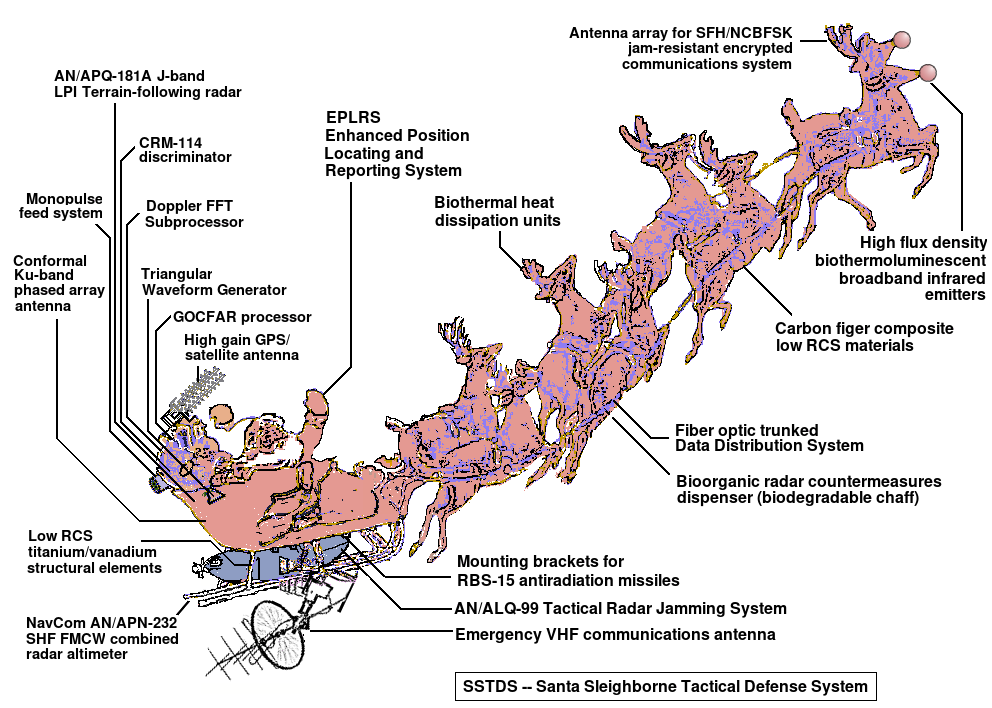
It’s possible they stop ‘believing’ or ‘pretending to believe’ shortly after they discover object permanence, which happens between 4 and 7 months. This is well before they start talking, which happens at between 10 and 15 months. If so, they’ve been lying to us for years!
Research bears this out. Boerger et al. [1] say that for 3–5 year olds, belief in a mythical being depends on textual cues. They write: “Children do not, in fact, believe everything adults tell them, but instead display limits to their credulity. They pay attention to adults’ intentional cues when determining whether their testimony is veridical.”
Santa Claus in the scientific literature
There are quite a few scientific articles on Santa Claus. One (in Norwegian) [2] says he is a global health threat.
Some claim that he is still alive, others doubt it. But as long as there is doubt, there is hope. But for the sake of the planet: let’s cross our fingers and hope he is dead. [computer translation]
They cite research claiming that Santa Claus’s journey produces around 1,000 tons of carbon dioxide and 60,000 tons of dust daily. “The reindeer’s stomach contains large quantities of microbes that produce methane from carbon dioxide and hydrogen. Methane absorbs sunlight and causes global warming with over 25 times the damaging potential of carbon dioxide (12).”
Clearly these guys are getting their fairy tales mixed up.
Another one titled “Dispelling the nice or naughty myth: retrospective observational study of Santa Claus” [3] correlated the presence of Santa Claus with rates of absenteeism, conviction rates, and contextual socioeconomic deprivation:
The results of this study dispel the traditional belief that Santa Claus rewards children based on how nice or naughty they have been in the previous year. Santa Claus is less likely to visit children in hospitals in the most deprived areas. Potential solutions include a review of Santa’s contract or employment of local Santas in poorly represented regions.
Another one points out [4] that unique occupational hazards exist for Santa Claus. The abstract promises to discuss “Major occupational health issues affecting Santa . . . along with suggestions for future research directions.“ These include the need to consider using coconut water for rehydration intravenously should Santa crash-land on a remote tropical island.
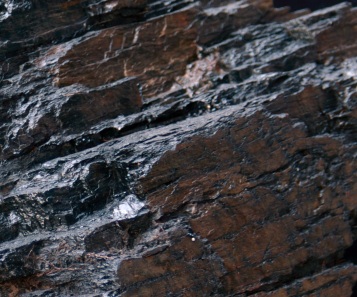
Parents know they’ll get in trouble for giving them coal. So if a kid wants it, he’ll have to dig it out of the ground and shellac it on his own
There are also epistemological questions:
According to popular legend and song he is, at least when performing his duties in the urban environment (“Santa Claus is coming to town” [17]) gifted with near-omniscience (“He sees you when you’re sleeping / He knows when you’re awake / He knows if you’ve been bad or good’).”[4]
It’s all tongue in cheek, of course. The only Santa Claus scientists believe in is NIH. But it’s an important topic. Jean Piaget thought that children exhibit magical thinking up to age 7 or 8. But they are highly motivated from birth to please their parents. If the parent seems to expect them to believe, kids will pretend to comply.
Children have many weapons in their arsenal, including the “smile,” which they know how to deploy with devastating effect. Another trick is working up tears and asking whether Santa Claus exists. The goal may be either to feign helplessness or to appear adorable in order to ensure continued acquisition of nutrients. As we are reminded each Halloween, obtaining an ample supply of carbohydrates is hard, grueling work, and they undertake it with deadly seriousness. Humoring their parents by pretending to believe in Santa Claus, the Easter Bunny, and whatever other childish fantasies the parent comes up with is just one more tool in the brutal struggle for survival.
[1] Boerger EA, Tullos A, Woolley JD. Return of the Candy Witch: individual differences in acceptance and stability of belief in a novel fantastical being. Br J Dev Psychol. 2009 Nov;27(Pt 4): 953–970. doi: 10.1348/026151008x398557. PMID: 19994488; PMCID: PMC2750897. Link
[2] Westin AA, Skjetne P (2002). Julenissen — En global helsetrussel [Santa Claus - a global health threat]. Tidsskr Nor Laegeforen. 2016 Dec 20;136(23-24): 2002–2004. Norwegian. doi: 10.4045/tidsskr.16.0627. PMID: 28004551. Link
[3] Park JJ, Coumbe BG, Park EH, Tse G, Subramanian SV, Chen JT. Dispelling the nice or naughty myth: retrospective observational study of Santa Claus. BMJ. 2016 Dec 14;355:i6355. doi: 10.1136/bmj.i6355. PMID: 27974338; PMCID: PMC5156612.
[4] Straube S, Fan X. The occupational health of Santa Claus. J Occup Med Toxicol. 2015 Dec 10;10:44. doi: 10.1186/s12995-015-0086-1. PMID: 26692887; PMCID: PMC4676089.
dec 19 2025, 6:18 am. updated dec 20 2025