ew things are as annoying as oversleeping until three a.m. and
discovering that last night’s clouds have already disappeared and
people in Florida are talking about the big aurora that you missed.
ew things are as annoying as oversleeping until three a.m. and
discovering that last night’s clouds have already disappeared and
people in Florida are talking about the big aurora that you missed.
If that happens, there are three tricks you can use. One is to take a picture anyway, as an aurora is often too faint to see by eye. Another is to search for auroras only in the winter, when there’s less haze. The third trick is to point your camera south.
Auroras in the south (Fig. 2) are fainter and tend to have a more purple color due to the blue of ionized nitrogen (N+2) mixing with the red from oxygen. There’s little or no green on the south and nothing on the horizon.
There are many advantages of shooting in the winter: the trees, which normally block the view, are bare, so you can see to the horizon; the local community’s swimming pool is empty, so you’re unlikely to get arrested; and the magnetosphere has gone wonky, so you’re just as likely to see an aurora pointing south as north.
This is great if, like me, you have not only a city north of you, but also a useless community swimming pool festooned with blazing floodlights from dusk to dawn, even when it’s closed for the winter. I went out around 4:00 to watch the airplanes landing and noticed a faint gray color in the sky. That’s typically all you can see by eye under such adverse conditions.
The faint purple in Fig. 2 is not airglow, but the remnants of the aurora, and it’s the second time I’ve seen one south of me.
It’s also worthwhile shooting straight up, as auroras are sometimes accompanied by Stable Red Arcs or SARs, which are mid-latitude horizon-to-horizon red structures that form equatorward during an aurora. They’re produced by heating (about 4000 K) instead of excitation from electrons.
At mid-latitudes, auroras and SARs are often too faint to be visible to the eye, but a DSLR set at ISO 1600 and ten seconds exposure will show them clearly. So it’s worth shooting them. As for the floodlights, please don’t shoot them no matter how tempting it may be.
nov 12 2025, 6:42 am
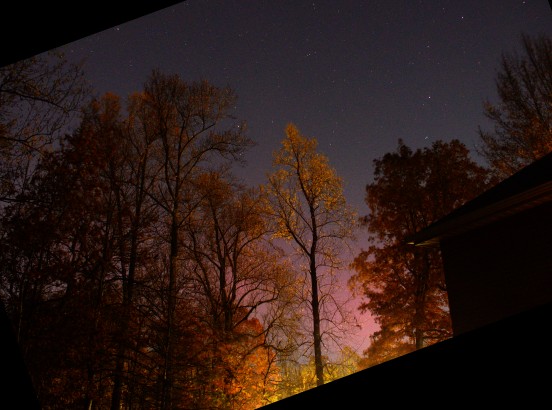
Fig. 1. Aurora Nov 12 2025, facing north toward the damn cement pond
swimming pool, which is cropped from the picture. This was all that was
left by 3:30 am when the clouds disappeared. The trees are illuminated
from below by giant floodlights that our HOA runs 365 days a year to use
up our HOA fees
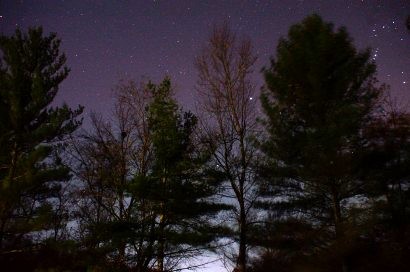
Fig. 2. Aurora Nov 12 2025, facing south. The white light near the horizon is the white floodlights illuminating the cosmos from the local airport. The purple color means it’s not airglow, which is red. The constellation of Orion is visible at right behind the pine tree