hese days, tinnitus researchers are regrouping from the transcranial
magnetic stimulation fad, which seems to have failed. Animal experiments,
where it’s hard to tell what the rats are responding to, have also mostly
been abandoned. There are more anecdotal treatments than clinically proven
ones. So in this update, I’ll include some populist remedies as well
hese days, tinnitus researchers are regrouping from the transcranial
magnetic stimulation fad, which seems to have failed. Animal experiments,
where it’s hard to tell what the rats are responding to, have also mostly
been abandoned. There are more anecdotal treatments than clinically proven
ones. So in this update, I’ll include some populist remedies as well
Trigeminal nerve
There is strong evidence for overlap between tinnitus and migraine, which originate from the auditory and trigeminal nerve pathways respectively. So one group speculated that CGRP (calcitonin gene-related peptide) inhibitors, which are used to treat migraine, might be useful for tinnitus.[1]
Diet and toxins
Can electrolyte imbalances affect tinnitus? There are differences in anecdotal reports between ringing tinnitus and hissing tinnitus. Ringing tinnitus can be caused by muscle spasm, so some patients say taking a magnesium tablet to balance the body’s Ca/Mg ratio can help relax the muscles in the ear and gradually reduce the chance of ringing tinnitus. The effect is said to take several hours to work. Ingesting too much magnesium can cause digestive problems, as some social media users, who thought it would help them sleep, found out the hard way.
Other anecdotal reports suggest that sodium could be associated with hissing tinnitus. Once again, the effect is unproven and could be indirect, but it can’t hurt to cut down on junk food that is high in salt.
However, among tinnitus researchers, the connection with diet is now mostly a backwater. One study [2] tried a multivariate statistical analysis and found that vitamin B12 correlated with lower tinnitus, while calcium, iron, and possibly fat increased it. Vitamin D and diets with high meat, fruit, and vegetables also correlated with improved hearing. However, the size of the effects was small. Only B12 (p=0.005), calcium (p=0.020), iron (p=0.007), and high protein (p=0.004) were statistically significant, while sugars, carbohydrates, magnesium, and polyunsaturated fats were not.
Another study [3] found that lead, cadmium,mercury and selenium blood levels correlated with tinnitus. Only cadmium correlated linearly; mercury had a threshold while lead didn’t depend on concentration at all above some small value.
Cognitive behavioral therapy
The current guidelines for tinnitus from the American Academy of Otolaryngology say to use cognitive behavioral therapy to treat tinnitus. This follows from the idea, widespread in medicine, that if something is impossible to measure or treat, it is ‘just anxiety.’ CBT makes no attempt to treat the disorder, but only tries to convince the patient that the noise is not a problem. CBT is not worthless; it is valuable in disorders like depression.
Low intensity noise suppression (LINTS)
The biggest news is the rediscovery that tailored sound can stop tinnitus.
Tziridis et al [4] ran a clinical study of 72 patients with hissing tinnitus to test the idea that tinnitus is a maladaptation of the auditory system to hearing loss. The authors say the most successful treatment for tinnitus is hearing restoration, but this is not available for patients with mild hearing loss. Their theory is that phantom sound is a side effect of normal feedback (which they call stochastic resonance) between the cochlea and the dorsal cochlear nucleus (DCN).
The idea is that noise is a normal phenomenon that depolarizes the DCN neurons to near threshold, which would increase their sensitivity. When the cochlea doesn’t produce enough of this noise, you get tinnitus. Therefore, they reason, applying low-intensity artificial noise between −4 and +6 dB sound level and about one octave bandwidth might replace this missing noise.
They reported positive results, but did not consider the alternative explanation of a masking effect. This is supported by the finding that giving patients a pre-treatment of white noise before switching to the LINTS eliminated the benefits of the treatment altogether. Most patients in the treatment group did not reach the threshold of 12 points improvement needed for clinical relevance.
Nonetheless, there is a real conceptual advance here: the recognition that narrowband noise mimicking the frequency of the tinnitus is essential. The authors used very low intensity so the artificial noise can’t be heard by the patient. As the authors say, for this to work the patient must match the frequency to their tinnitus, and octave errors would make the treatment useless.
Matching the frequency is even more effective at eliminating ringing tinnitus, as I reported here. For this to work, the patient would need to adjust a sound generator (such as a piano or an audio oscillator *) to match the pitch of the ringing to within a few hertz. As noted, suppressing the ringing often causes the ringing to jump to a nearby frequency. To stop it completely, the patient would have to adjust their sound generator to maintain the effect. An octave difference, where the pitch is the same note on a piano but one octave high or low, might sound the same to the patient but it won’t work.
Sound enrichment therapy
In a similar trial, Sendesen et al. [5] applied a spectrally matched noise band and compared continuous sound to sound amplitude-modulated with a 10 Hz sine wave. The idea is that this low-pitched component causes the tinnitus suppression to last longer instead of returning after a few minutes. They reported that 18.51% of patients got complete suppression, compared with 4.54% with unmodulated sound. The difference between modulated and unmodulated was barely significant (p=0.049). In this test, the sound was at audible levels (the highest level above the minimum masking level that didn’t cause discomfort) and presented for six hours a day. The authors speculated that the 10 Hz signal entrains neural oscillations and reorganizes neuronal firing patterns.
These results might not sound impressive, but they show that researchers are now convinced that hearing loss is the principal cause of tinnitus and restoring sound can suppress it.
Amplitude-modulating the tone makes sense because it would add sidebands around the main frequency in case the ringing changed pitch because of the tone, as it often does. If so, frequency modulation should be even more effective.
Psychopaths with tinnitus
That might sound like a really bad sci-fi movie, but Blecking et al., [6] in a classic case of “Why not?” tested tinnitus sufferers for neuropsychiatric disorders. They found that 96% of tinnitus sufferers had at least one “diagnosis pointer” such as major depression, agoraphobia, health anxiety, anorexia nervosa, and psychosis.
The article was interesting but not entirely convincing: a good example of why we should always be skeptical even when reading the science literature.
* There are inexpensive DDS signal generators like the JDS8060, which can create modulated sine waves that you could use to test the sound enrichment theory. It does not generate white noise. I can’t yet vouch for its effectiveness but the 10 Hz modulated sine wave is definitely very annoying. This device is reliable but tends to get stuck in modes where some features stop working. Their software actually recognizes the device but I could find no way to restore factory settings with the Windows app. My advice: if you get it to work, don't touch it.
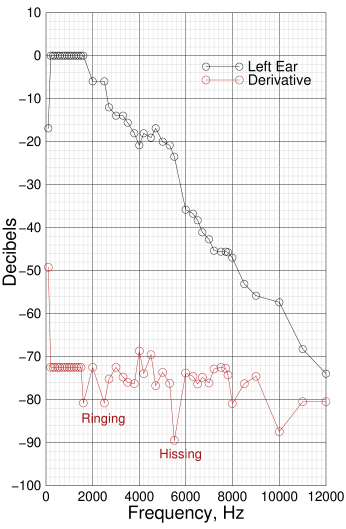
Audiogram showing frequencies of hearing loss. The y-axis is calibrated to decibels but is not corrected by the A threshold curve for human hearing (ISO curve) so it is not a true audiogram. Red curve shows slope of the black curve
Sound samples
Below are some sound files recorded from the JDS8060 to give you an idea what Sound Enrichment Therapy would sound like.
2500 Hz sine wave AM-modulated with a 10 Hz sine wave, 100% modulation (5 seconds)
The frequency-modulated tone below is even more annoying. The theory suggests that it would be more effective.
2500 Hz sine wave FM-modulated with a 10 Hz sine wave, 100 Hz deviation (5 seconds)
This budget sound generator isn’t good enough to do professional audiometry. The lowest voltage it can create is 1 mV, so all the data points below 1600 Hz appear saturated. Above 5 volts, it produces extra tones at the wrong frequency.
Here is what 8060 produces when set to ‘noise’, slowed down to 18 Hz.
18 Hz noise, unmodulated (5 seconds)
Some other more expensive waveform generators can produce white noise, but they’re not as easy to use. It’s easier just to use an FM radio and an equalizer.
The graph at right shows the SPL in decibels calculated from the voltage needed to produce a barely audible tone using headphones. The curve is not corrected for iso226 hearing response, so it's not a true audiogram.
Even so, we can see that there might be a correlation between the slopes of the fall-off curve and the frequencies of hissing tinnitus (∼5000 Hz) and maybe ringing tinnitus (in this case 2000–3000 Hz). This hints that there could be an edge effect.
What we really need is some way to analyze the nerve signals going from the DCN to the ear. If the feedback hypothesis is correct, this would let us tailor the sound to provide the needed feedback.
[1] Dichter A, Bhatt K, Gutérrez Pérez ML, Lee EJ, Tawk K, Djalilian HR. Potential therapeutic role of calcitonin gene-related peptide medications for tinnitus. J Chin Med Assoc. 2026 Mar 1;89(3):198–203. doi: 10.1097/JCMA.0000000000001351. PMID: 41612541; PMCID: PMC13004237.
[2] Dawes P, Cruickshanks KJ, Marsden A, Moore DR, Munro KJ (2020). Relationship Between Diet, Tinnitus, and Hearing Difficulties Ear Hear. Mar/Apr;41(2):289–299. doi: 10.1097/AUD.0000000000000765. PMID: 31356390 PMCID: PMC7664714 DOI: 10.1097/AUD.0000000000000765
[3] Jin X, Si S, Cui Z, Jin Y. Analysis of the association between blood heavy metals and tinnitus. Medicine (Baltimore). 2026 Mar 6;105(10):e47707. doi: 10.1097/MD.0000000000047707. PMID: 41790712; PMCID: PMC12975176.
[4] Tziridis K, Heep L, Piwonski N, Nguyen K, Kölbl, N, Schilling A, Schulze H (2025). Phase II Clinical Study on Low-Intensity-Noise Tinnitus Suppression (LINTS) for Tinnitus Treatment. Brain Sci. 15, 1222. https://doi.org/10.3390/brainsci15111222
[5] Sendesen E, Colak H, Sendesen I (2026).Sound enrichment therapy is more effective for long-term tinnitus suppression with 10 Hz amplitude modulation. Hearing Res 270, 109513 https://doi.org/10.1016/j.heares.2025.109513.
[6] Boecking B, Steinmetzger K, Brueggemann P, Rose M, Mazurek B. Transdiagnostic dimensions of psychopathology in chronic tinnitus patients with and without hearing loss. Sci Rep. 2026 Jan 16;16(1):2618. doi: 10.1038/s41598-025-32526-5. Erratum in: Sci Rep. 2026 Mar 3;16(1):7999. doi: 10.1038/s41598-026-42649-y. PMID: 41545380; PMCID: PMC12820050.
mar 22 2026, 7:24 am. updated mar 31 2026