century ago, nearly every middle-class home had an acoustic piano.
Affordable, low-quality pianos proliferated. They had the same limitations
as the good ones: they were big and heavy, noisy, and required annual
maintenance and tuning. Their tone wasn't as good and they still required
practice. The classic example is the little kid driving everyone up the
wall by artlessly plonking out the same tune over and over.
century ago, nearly every middle-class home had an acoustic piano.
Affordable, low-quality pianos proliferated. They had the same limitations
as the good ones: they were big and heavy, noisy, and required annual
maintenance and tuning. Their tone wasn't as good and they still required
practice. The classic example is the little kid driving everyone up the
wall by artlessly plonking out the same tune over and over.
When digital pianos were invented, it seemed as if the problem was solved: digitals never needed tuning, they were easy to move, and your kid could use headphones. They had settings for church organ and sine waves. And you could attach them to an inexpensive sound effects processor like the Behringer to make it sound like you’re in Carnegie Hall (at least until the Behringer's CPU blew up).
But that’s as close as you’ll ever get. A digital is not a real instrument, only a recording of one. Even the high-end ones that advertise escapements and resonance don’t come near the range of sound as an acoustic. You can’t produce a harsh sound from a digital, but you can’t get a beautiful melodic sound either. As the owners' ears improve, they typically find themselves finding fault with it.
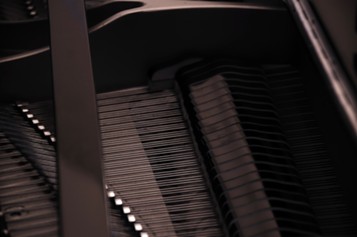
Inside view of an acoustic piano
This may be why even the digital piano sales are declining, but there are other reasons.
One the snob factor. There are lots of snobs out there who pretend to like classical piano music because they think it gives them social status. Thus, people think pianos are only for snobs, and since they hate snobs they conclude that they must also hate classical music.
Many pros play music they obviously hate. For instance, it is said that Mozart is the hardest for experts. The reason they give is that Mozart requires absolute precision. One misplaced note and the whole world knows it. It is a challenging physical task as well as an intellectual one. Playing a grand piano, as one expert says, requires immense concentration.
If the pianist hates the music, it shows in their playing. The playing becomes exaggerated. Romantic style turns sickeningly sentimental. Other times it becomes an exercise in keeping the listener glued to the volume control: parts of it are so faint it's drowned out by the neighbor's deer munching on their bushes. Then a moment later, it becomes insanely loud, risking the listener's hearing.
People pick up on that because they’ve never heard it played by somebody who doesn’t hate it. Even compositions by Arnold Schönberg, perhaps the most hated composer of all time, have musicality in them. We know this because Glenn Gould was somehow able to hum along with it.
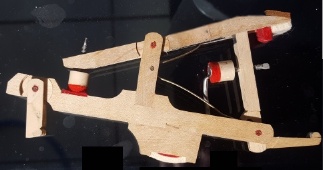
A wippen is the part in an acoustic grand piano that transfers kinetic energy from the key to the hammer. The beige vertical part on the left is a plastic wippen flange. The other parts are wood. The brass pins are surrounded by red felt and are showing some corrosion. I’d consider this wippen to be merely satisfactory
Hating music is not an obstacle
Admittedly, hating music could pose a challenge for any instrument, but it gets to the fundamental reason of why you still need a piano. It can be an intellectual challenge to see if you can make a bad piano piece sound tolerable.
Many technical people, who see the piano in terms of resonances and frictional forces, have pianos. To us, a piano is essentially an old-fashioned waveform generator. You could, for instance, attach both ends of a string to an amplifier, then place a magnet next to the string, and experiment with generating tones electronically, bypassing a microphone. So a piano can be useful even if, like me, you have no musical ability. In fact, I think everybody has ability: there are no bad pianists, only unsuccessful piano teachers.
Finally, if you have kids they’ll have hours of fun strumming on the strings. In retrospect, I suspect this may be why the one we had when I was a kid got sold before we could get our greasy paws on it.
We need to get rid of the idea that classical music is supposed to be pretentious, sentimental, and artsy.
Where are all the piano teachers?
A teacher can benefit students by showing them how to create a good tone from a piano and helping train their ears to recognize it. A piano teacher can also help the student avoid injury when playing, which is the usual result of bad technique.
But piano teachers gain status by creating professionals. This is why it is often said they won’t take adults. If the student gets into Juilliard, the teacher gets praise. If the student just dies of old age, the teacher gets nothing.
Digitals and acoustics are different instruments
Someone who learned on a digital piano faces a massive new learning curve when transitioning to an acoustic one. Bad habits and assumptions must be unlearned. Unlike in a digital, where the only difference between a soft and loud keystrike is the volume, in an acoustic a soft note sounds vastly different from a loud one. This may be the reason piano teachers often refuse to teach anyone unless they have an acoustic. Getting an amazing sound out of an acoustic is very difficult, especially if it's old. You can learn to play nicely on a digital, but they’re really two different instruments.
Why are used pianos bad?
But there's a problem. Contrary to popular belief, buying an old used piano is rarely a good idea unless you’re good at fixing things.
On my used piano, half the notes wouldn’t play unless I banged on the key. Key #37 just stayed up if I lifted it up and key #44 wouldn’t do anything at all. The rest just hurt my ears. This happens because as a piano ages, the hammers get harder and the piano loses its mellow tone and becomes harsh. The keys become harder to press because the hinges on the hammers and wippens get corroded. It also goes out of regulation, which means it is uneven and unresponsive. To play at all, I had to use Walker’s Razor X-trm earmuffs, which are designed for people practicing at a shooting range. Even then, I had to drape heavy acoustic blankets over my piano to protect my hearing. Pianos make a lot of sound. Who knew?
The earmuffs also protect me from having to listen to my own attempts to play.
You will also discover, as I did, that piano technicians will decline to work on it. It is tedious, time-consuming work. Regulating a piano can easily cost more than the piano is worth.* Even if you convince them you’re willing to pay the $4000 it might cost, many will still decline because status in their profession comes from working on Steinways, which can cost over $171,000, not used ones or junk pianos somebody found abandoned in the woods.
Those forest-dwelling pianos are out there because it would have cost more to move it to the owner's new residence than it was worth. Piano experts say a piano never increases in value. In their eyes, an antique piano, while nice enough as furniture, is “junk” as a musical instrument, again unless it’s a Steinway. I saw one beat-up Steinway in a piano store that I thought qualified as junk, but a week later somebody actually purchased it.
That is elitism, and it is harming the industry: people discover they can’t get their pianos repaired, they stop buying pianos, and prices increase to compensate, which drives away customers. Just last month the last piano dealer in my area closed and went out of business.
If you can’t afford a new one, and you’re not afraid of spending time learning how to make it playable, you can get a good one and a valuable free course in piano technology.
What do I need to know before restoring my piano?
Step #1 is to buy a copy of Reblitz, Boone, or some other book, learn what parts are important, and then do what they say. Then do whatever else it takes to make it playable, even if it means breaking a few rules. It could be simply a matter of cleaning, polishing, and burnishing the thousands of parts, and then learning how to regulate it. This could take a month of solid work, but the reward is a thorough understanding of what your piano is doing. Just remember to clean up all the blood afterward. But my advice is to ask a pro to do the work. Waving a wad of hundred-dollar bills at them can work wonders. (I think. It’s one of those things that if you can do it, you don’t need to.)
Don’t listen to those guys on the Internet who tell you to soak your wippens in lacquer thinner to remove the verdigris. Some wippens have plastic parts, which will dissolve. Verdigris shows up mostly on the outside of a pin, so judicious scrubbing with ethanol or aqueous ammonia with a Q-tip or toothbrush might be enough. If that fails, you can re-pin it, which isn’t hard. Even pros sometimes give bad advice. One piano tuner told me to get a Dampp-Chaser before he would tune it, then changed his phone number. Even Reblitz says those humidity-controlling gadgets don’t work on a grand piano.
You might find little pieces of paper underneath some of the parts. Don’t throw them away. They were installed because the part was warped and needed tilting. Or you may find green guck coming out of the flange pins. Or you may find screwholes that were stripped and parts that need light sanding or trimming with a razor blade. This means you’ll need to know how to tap holes and maybe even repair broken pieces of wood properly.
The hard part is resisting the urge to re-engineer your piano.
The last step is to voice the hammers. Experts say that voicing should be left to a pro. They'll only do it if it's already tuned and regulated. The hard part is convincing them to do the work, but it’s also a challenge just getting them to answer their phone. It might just be that they’re hard of hearing from tuning pianos. It’s an occupational hazard.
Sounds great! What other advantages are there?
A piano is quite big, so unlike your car keys and your sunglasses, it will never get lost. No burglar is ever likely to steal it. Also, when everything electronic is wiped out by the next Carrington event, you’ll still be able to play it. That’s about it.
The other advantage is that you can play things the way you think they should be played. You can add as many extra notes as you want. Who can stop you? The fact is, it’s not enough to give your piano a good wippen to make it play better. You have to give it 88 good wippens.
But my advice is: if you’re thinking about buying a piano, call a piano technician first to see if they’re willing to work on it. If they aren’t, don’t buy the piano.
* Update, mar 01 2026: Contrary to what most people think, the amount a piano is worth is not the amount you can sell it for. It is the amount you’d have to pay to replace it with one that does what you need. So a $3000 piano that can be restored could actually be “worth” $20–30,000 because the owner is now smart enough not to buy another used one. If so, putting $4000 into it might be a wise choice.
feb 10 2026, 5:51 am