here’s a big
debate on some physics forums as to whether the
three-polarizer phenomenon is proof of quantum mechanics or not.
Here’s the experiment.
here’s a big
debate on some physics forums as to whether the
three-polarizer phenomenon is proof of quantum mechanics or not.
Here’s the experiment.
Take three light polarizing filters. Polarized sunglasses will work. Cross two of them to block out the light. Then put the third one between them at a 45 degree angle. You will observe that the light is no longer blocked. An LCD TV is a good light source and can substitute for the first polarizer, as a backlit LCD TV emits polarized light.
(LCD / active matrix TFT computer monitors also emit polarized light. Oddly enough, even units with the same model number, such as the Dell Ultrasharp U2419H, can have opposite polarizations. I have two on my desk: one is horizontally polarized, the other is vertical.)
To understand how weird this effect really is, ask yourself: when was the last time you put an absorbance filter in a light path and it made the light brighter? Logic tells us the third filter could only make it dimmer. So something odd is happening.
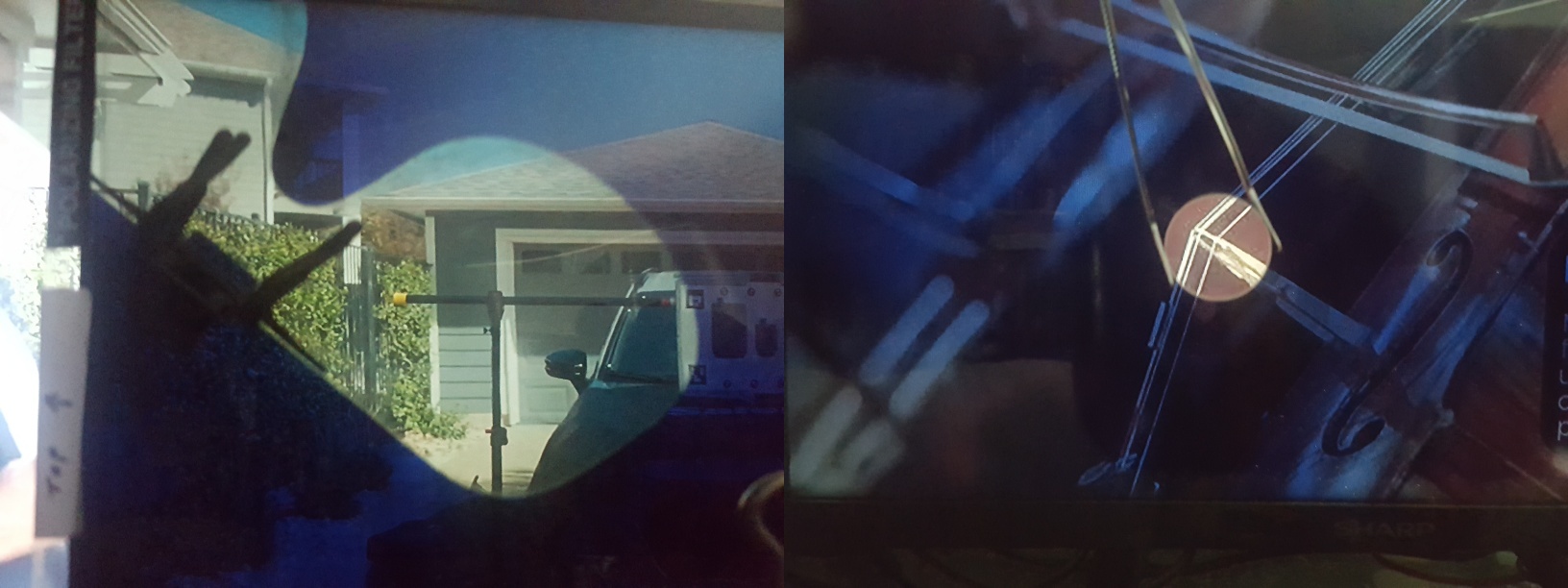
Image of an LCD TV using two crossed polarizers at 45 degrees
Experimental tests
Linear polarizing filters don’t change the polarization state of light and they don’t create circularly polarized light. They merely block polarization in one direction. So how could this work? Let’s get some actual numbers.
A plastic polarization sheet will reduce light intensity by 16.8% due to reflection and absorption and reduce the remainder by 50% by polarization. The light can be easily measured using a photocell (taken from a broken landscape light), a voltmeter, and a light source. I also added a variety of filters to test the effect of wavelength.
With a 10-watt white LED lamp and a blue Wratten 47B filter, the 45° middle polarizer increased the transmitted light by 6.61×. No increase was seen with R72 (long pass near-infrared) or H-alpha (narrowband 656.3 nm) filters, indicating that the effect doesn’t work with near-infrared light. Ordinary halogen lamps also don’t work, due to some peculiarity in the detector. (The effect could be seen visually but it didn’t show up as a voltage change.) A green (532 nm) semiconductor laser showed the biggest effect: a 46.68× increase (from 0.165 to 7.703 mV); however, the laser itself emits polarized light, which would have affected the result. A green LED was the best light source.
Glass polarization filters worked better than plastic, but at most only 25% of the incoming light was ever restored. For example, the signal from the green LED was reduced from 12.965 mV to 0.061 mV by two crossed polarizers, a loss of 99.53%. When the third 45° filter was added, it increased to 0.545 mV, an 8.93× increase, but still only 4% of the original brightness. Correcting for reflection losses only increased this number to 7.3%.
Effect of angle
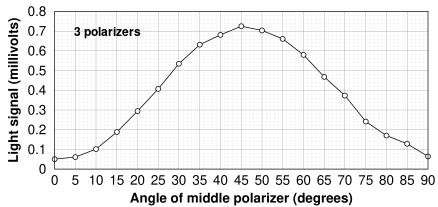
Effect of third polarizer angle
If the third polarizer were merely passing photons because it is inefficient, we might expect that the angle wouldn’t be important. In fact, we see an almost perfectly symmetrical curve peaking at 45°, where 14.2× more light reaches the detector than when the third filter was absent (see graph above). This was 20.9% of the reading from two uncrossed polarizers.
| Configuration | Signal (mV) | mV × |
| Single filter | 4.072 | |
| Two uncrossed filters | 3.463 | |
| Two crossed filters | 0.082 | |
| Two crossed filters and third filter between them | ||
| Third filter at 0 degrees | 0.051 | 0.662 |
| Third filter at 45 degrees | 0.725 | 8.842 |
| Third filter at 90 degrees | 0.065 | 0.793 |
This rules out the idea that the third filter is simply making the photons ‘forget’ their original polarization. It also argues against the idea that quantum states are involved.
The four-polarizer test
If the third filter is simply absorbing, randomizing, and then repolarizing some of the light, adding a 4th polarizer between #2 and #3 and fixing polarizer #2 at 30° should change the maximum from 45 to 60 degrees. This is exactly what happens (see graph below). This might suggest that the filters could be absorbing and repolarizing a small amount of the incoming light.
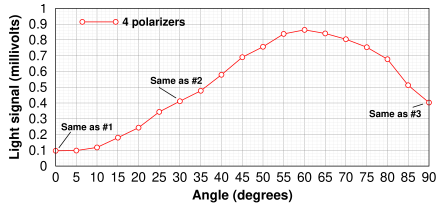
Effect of four polarizers with #2 fixed at 30°
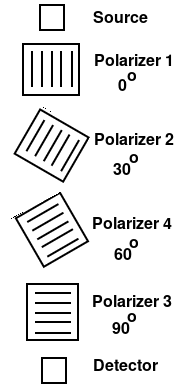
Setup of 4-polarizer test
| Configuration | Signal (mV) | mV × |
| No filters | 9.430 | |
| Single filter | 4.072 | |
| Two uncrossed filters | 3.202 | |
| Two crossed filters | 0.067 | |
| Fourth filter between #2 and #3 | ||
| Fourth filter at 0° (same as #1) | 0.097 | 1.44 |
| Fourth filter at 30° (same as #2) | 0.411 | 6.09 |
| Fourth filter at 60° (halfway bet. #2 and #3) | 0.862 | 12.78 |
| Fourth filter at 90° (same as #3) | 0.403 | 5.97 |
Calcite test
However, that theory is incorrect. When I substituted a calcite crystal for the middle polarizer in the 3-polarizer test, the calcite showed the same effect.
Calcite (calcium carbonate) is birefringent. When you examine an image through a piece of calcite, it splits into two images, each with opposite polarization. The two images are shifted slightly. If you examine them through a polarizing filter, rotating the filter changes the view from one to the other. If the crystal is between two crossed filters and tilted to 45°, it restores the light just as polarizing film would do (see figure below). Calcite is transparent and colorless, which means it could not be absorbing the incident light.
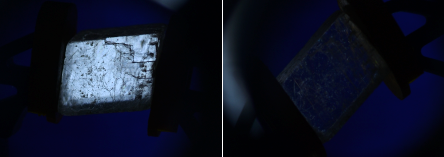
Calcite between crossed polarizers. Left shows that a calcite crystal rotates the plane of light and when tilted to 45° it restores the blocked light.
Many other substances, including many plastics, show the same effect. In fact, there’s a whole branch of science that involves sticking things between crossed polarizers and observing the colorful stress patterns. My calcite specimen had been lying in my sock drawer since 1962, so it was a little scratched up. But this test rules out the ‘absorption’ theory.
Setup for plain glass polarizer test
Glass test
Plastic polarization sheets, calcite crystals, and conventional glass polarizers all work by birefringence. Birefringence is a polarization-dependent change in the light path caused by an asymmetric shape in the molecule. So what happens if we use a polarizer that acts by some other method? To find out, I used an ordinary piece of glass set at Brewster's angle, which is arctan(n2 / n1), where n1 is the refractive index of air (1.0) and n2 is the refractive index of the glass (1.513 for soda-lime glass). In this setup, Brewster’s angle should be 56.54 degrees. Light reflected by a non-metallic, non-scattering surface at this angle is 100% polarized.
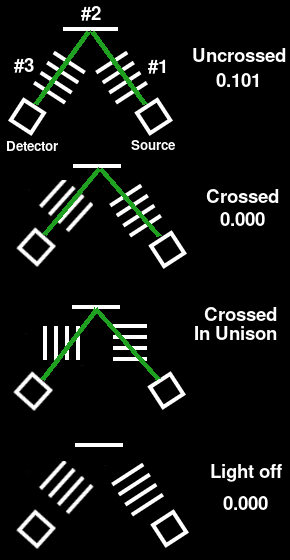
Obviously for this test we can’t rotate the middle polarizer. Instead, we will rotate the two crossed ones in unison. If there is an increase at 45 degrees, it will show that the light restoration is due to polarization and not some weird effect of birefringence.
The polarizers used here were specially made to be more precise than commercial ones. They were also adjustable, so their polarization could be aligned without touching the filter. A collimating lens was used to give a bigger signal, but even so the signal was only 22% as strong as when a mirror was substituted for the glass. This means most of the light was transmitted and absorbed in the black felt behind the glass (see photo below).
In this test, polarizer #1 was vertically polarized when set to 90° and polarizer #3 was horizontally polarized when set to 90°. They were rotated in synchrony. The result (green curve below) shows a clear maximum at 45 degrees. The highest signal was 0.061 millivolts, which was 25.5% of the maximum signal obtained from uncrossed polarizers (0.239 mV).
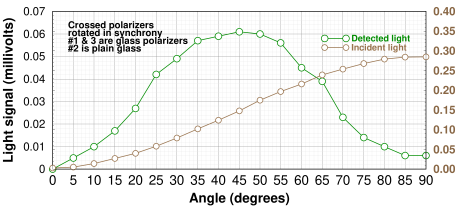
Green: Signal from crossed polarizers using plain glass polarizer
Brown: Light from #1 + glass polarizer with #3 removed
Note the different scale for the brown curve
Is there a connection between the 45-degree effect and Brewster‘s angle (56.54°)? The answer is no. When polarizer #3 was removed, the biggest signal was obtained not at 56 degrees, but at 90 degrees (brown curve). This makes sense because at 90° the polarization was vertical and the plain glass was oriented vertically on the bench, so it produced vertically polarized light. Yet with crossed polarizers the maximum was at 45°. This shows the 45° effect was still occurring.
Whatever is happening in the 45-degree effect, it’s not just that the incoming light happens to match the optimum angle for polarization. These results show that the 45-degree effect is not caused by birefringence but is a property of polarization.
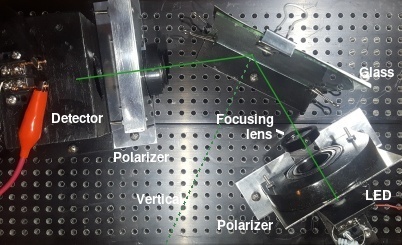
Plain glass polarizer test setup. Polarization from glass happens
at 56.5° from the vertical, so the angle between source
and detector has to be 113°. Black felt was clipped to
the back of the glass to absorb any transmitted light.
At these weird angles, components with two holes
never line up with the holes on the table
How does this work?
Is quantum mechanics involved? Polarized light is a permanent fixture in most quantum mechanics books. Some people suggest that the three-polarizer effect is connected to the fact that light exists in two quantumly superposed polarization states. J. J. Sakurai in Modern Quantum Mechanics calls the three filters x (at 0°), x′ (which is at 45°), and y (which is at 90°) and notes that light is created at a polarization it didn’t have before:
[T]here is a light beam coming out of the y-filter despite the fact that right after the beam went through the x-filter it did not have any polarization component in the y-direction. . . . The selection of the x′-polarized beam by the second Polaroid destroys any previous information on light polarization.
Sakurai doesn’t seem to care about the effect other than to use it as an illustration of how polarization vectors are real and non-intuitive even for everyday phenomena. His interpretation is that the middle filter takes the polarized light, makes it ‘forget’ its original polarization, and adds its own new polarization state. How that could happen is a mystery. If the “destroying information” theory were true, then crossed polarizers wouldn’t block 99.53% of the light. The numbers also clearly show that it’s not just “crushing” the incoming light as SGOTI is saying.
Sakurai compares it to the famous 1922 Stern-Gerlach experiment, which showed that silver atoms possessed possessed a quantized spin state which allowed them to be separated into two beams by an inhomogeneous magnetic field. According to Sakurai, the abstract vector space that describes those spin states is analogous to the polarization vectors of the classical electromagnetic field.
There’s even still a debate about what’s causing those silver atoms to move. Van der Straten says (p. 135) that spin (i.e. angular momentum) has nothing to do with it and the S-G effect is solely due to magnetic moment (which is determined by the spin). We know the magnetic field isn’t changing the rotation of the silver atoms because it is the spin of the single unpaired electron that provides the angular momentum (or magnetic moment if you prefer). This electron is not in any fixed location around the nucleus, so it would be impossible for it to cause alignment of the atom in a field. It can only cause movement toward or away from the magnetic field.
It’s remarkable that people are still arguing about the niceties of the S-G experiment a hundred years later. No doubt they’ll be arguing about the three polarizer effect for just as long.
jun 23 2026, 7:40 am. last updated jul 16 2026, 6:10 am