hy do women like flowers so much? Ask that question on the
Internet and you find article after article gushing over something
called “feelings,” whatever those are. Others try to
relate it to dopamine, the all-purpose neurotransmitter that
the humans have glommed onto as a supposed reward molecule.
Technically, I suppose you could ask them, but then you’d run into the problem that bedevils experimental psychologists: 99 percent of what every human says is a lie and the other one percent is false. We must use other means to answer the question.
There are over 1700 volatile organic compounds, called VOCs, emitted by flowers, mostly in three classes: terpenoids, benzenoids, and fatty acid/amino acid derivatives.[1] Odors like lavender, rose, and jasmine, it is claimed, lower cortisol levels, thereby reducing stress, while the virtually identical smell from a stinkbug does not. This implies that the effect is purely psychological. But among other species, flower VOCs have potent effects on behavior. Could the same be happening with humans? There are several theories.
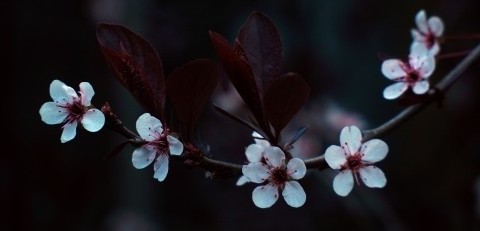
Prunus domestica (plum tree) flowers emit numerous volatile organic compounds including β-myrcene, α-pinene, camphene, and γ-terpinene [2]. These terpenoid VOCs are effective against protozoal infections such as trypanosomiasis and leprosy, suggesting that the giving women flowers is a form of medical treatment
Theory #1: Evolution Women evolved to gather vegetables and fruits for the purpose of making salads and fruit smoothies for cavemen. They were therefore forced to utilize their olfactory receptors to assist in locating them. Over generations, they evolved to be happy when they located a suitable plant, as this meant increased survival for the tribe.
Theory #2: Protection against fungi Many VOCs are emitted as a sign of injury to the plant. Beta-caryophyllene is emitted by apple trees infected by fungus. Other VOCs, such as linalool and methyl salicylate, function to repel aphids. Plants can utilize VOCs as a form of communication to synchronize their anthesis, so that they all bloom simultaneously when no predators are present. Conversely, the snapdragon (Antirrhinium majus) emits methyl benzoate, which injures nearby plants by inhibiting their root growth.
Coriander emits VOCs linalool (a terpene), 1,8-cineole (eucalyptol), and (E)-2-dodecenal and (E)-2-tetradecenal.[3,4] The plant uses these oxygen-containing lipid molecules to repel armyworm (Spodoptera frugiperda), a species of moth. Brown marmorated stinkbugs (Halyomorpha halys) emit a nearly identical odor, and indeed, like coriander, stinkbug VOCs contain trans-2-decenal or trans-2-octenal, and tridecane; and an (E)-2-aldehyde such as (E)-2-decenal or 4-oxo-(E)-2-hexenal.
Thus, this theory suggests that women are happy to receive flowers because they provide assistance in warding off fungi and harmful insects such as moths and aphids.
Theory #3: Sex pheromones The VOCs from some plants, such as orchids, mimic sex pheromones of insects, inducing the insects to engage in pseudo-copulation with the flower while actually unwittingly doing the flower’s bidding by distributing pollen for it.[5] These VOCs include common terpenoids like geraniol and linalool and rarer fatty acid derivatives made from hydroperoxide intermediates including jasmonic acid and methyl jasmonate.[6]
Drakolide 1, produced by the Australian orchid Drakaea livida, a β-ketolactone, is a sexual attractant to pollinating bees, but only if it’s paired with a specific pyrazine-type molecule, demonstrating that pheromones are not a simple as we thought, even in bugs.[7]
Thus, we might speculate that some combination of VOCs from flowery plants could have a structural resemblance to the human sex pheromone, if there is one, subconsciously activating the woman’s desire to reproduce. Unfortunately, research aimed at identifying human pheromones is plagued by three unshakeable beliefs: (1) we already know what they are; (2) only animals and bugs, but not humans, have them; and (3) humans have enough problems with sex as it is.
Theory #4: Cannibalism Many flowering plants, including Pyrus calleryana (Bradford pear), Stapelia spp. (carrion flower), Rafflesia arnoldii (corpse flower), and Helicodiceros muscivorus (Dead Horse Arum), emit odors reminiscent of dead animals and rotting meat. This smell usually comes from indole and indole derivatives like skatole (3-methyl indole). The female Ginkgo tree (Ginkgo biloba) emits a foul odor similar to vomit and sewage. The goal may be to attract predators such as predatory wasps or mites which can eat other insects that may be attacking the plant. This doesn’t always work, as the sewage-like fragrance can inadvertently attract florivores.
Some VOCs induce cannibalism in herbivore species, inducing the bugs to eat each other instead of the plant. One example is guaiacol (2-methoxyphenol). At low concentrations, it activates immune pathways in locusts, increasing their survival. At high concentrations, it induces cannibalism among the locusts, attracting them to ingest their injured comrades.[8]
Finally, since we all know that global warming is responsible for all bad things, it may be relevant that fall armyworms Spodoptera frugiperda eat each other more often at higher temperatures. The authors blamed global warming, but in fact these armyworms were responding to seasonal changes in temperature. When it’s cold out, they can’t eat each other because, being bugs, it’s harder for them to move. But you can’t get a paper published for discovering that.[9]
This theory seems to be the one best supported by evidence from the animal kingdom. Women don’t actually like flowers. The chemicals emitted by flowers awaken some primordial impulse in women that appears to us as happiness. But then there’s that toothy smile . . . .
[1] Lo MM, Benfodda Z, Molinié R, Meffre P. Volatile Organic Compounds Emitted by Flowers: Ecological Roles, Production by Plants, Extraction, and Identification. Plants (Basel). 2024 Jan 31;13(3):417. doi: 10.3390/plants13030417. PMID: 38337950; PMCID: PMC10857460.
[2] Baraldi R, Rapparini F, Rossi F, Latella A, Ciccioli P (1999) Volatile organic compound emissions from flowers of the most occurring and economically important species of fruit trees. Phys. Chem. Earth (B) 24(6), 729–732.
[3] Zhong Y, Zhao W, Lin L, Chai Y, Xie M, Li X, Zhang F, Li F, Tang R, Chen H. Coriander Derived E-2-Decenal Repels Fall Armyworm through Dedicated Olfactory Coding Involving SfruOBP13. J Agric Food Chem. 2025 Aug 20;73(33):20770–20778. doi: 10.1021/acs.jafc.5c06783. PMID: 40784033.
[4] Kumar S, Ahmad R, Saeed S, Azeem M, Mozūaitis R, Borg-Karlson AK, Zhu G. Chemical Composition of Fresh Leaves Headspace Aroma and Essential Oils of Four Coriander Cultivars. Front Plant Sci. 2022 Feb 17;13:820644. doi: 10.3389/fpls.2022.820644. PMID: 35251089; PMCID: PMC8891447.
[5] Cozzolino S, Scopece G. Specificity in pollination and consequences for postmating reproductive isolation in deceptive Mediterranean orchids. Philos Trans R Soc Lond B Biol Sci. 2008 Sep 27;363(1506):3037–3046. doi: 10.1098/rstb.2008.0079. PMID: 18579475; PMCID: PMC2607316.
[6] Ramya M, Jang S, An HR, Lee SY, Park PM, Park PH. Volatile Organic Compounds from Orchids: From Synthesis and Function to Gene Regulation. Int J Mol Sci. 2020 Feb 10;21(3):1160. doi: 10.3390/ijms21031160. PMID: 32050562; PMCID: PMC7037033.
[7] Slavković F, Bendahmane A. Plants, Pollinators and Pheromones: Promises and Lies of Semiochemicals. Plant Cell Environ. 2025 Sep;48(9):6865–6873. doi: 10.1111/pce.15670. PMID: 40464418; PMCID: PMC12319300.
[8] Han W, Lu T, Xie W, Yuan J, Lu C, Shang L, Wang G, Hansson BS, Chang H. Injury-induced signalling coordinates immunity and cannibalism in locusts. Nature. 2026 Nov 18. doi: 10.1038/s41586-026-11297-7. PMID: 43052446. https://www.nature.com/articles/s41586-026-11297-7
[9] Rougeau K, Elderd BD. We Are Dying to Eat You: Cannibalism and Disease Transmission Under Global Climate Change. Ecol Evol. 2026 Sep 28;16(10):e74403. doi: 10.1002/ece3.74403. PMID: 42812479; PMCID: PMC13619740.
nov 28 2026, 7:15 am