igh levels of carbon dioxide (CO2) can cause unexplained
drowsiness, difficulty concentrating, and headaches.
A bedroom can easily reach 1000 ppm from one person sleeping in it.
At that level, you’ll wake up at 2 AM with an irresistible urge
to go outside and breathe something.
igh levels of carbon dioxide (CO2) can cause unexplained
drowsiness, difficulty concentrating, and headaches.
A bedroom can easily reach 1000 ppm from one person sleeping in it.
At that level, you’ll wake up at 2 AM with an irresistible urge
to go outside and breathe something.
Most people agree that liquid nitrogen should never be in a cold room, but people are amazingly careless about carbon dioxide, which can be just as deadly. I’ve seen ice buckets filled with ten pounds dry ice sitting in a cold room (4°C on the rare occasions when it was working); fifty pound boxes of dry ice stored in a −80°C freezer, and hundred-pound shipments in an ice chest in a lab. One guy drove 200 miles with a cardboard box filled with dry ice in his car—and somehow lived to tell about it.
NIOSH says 5000 ppm total weighted average over 8 hr (TWA) is immediately dangerous to life or health (IDLH). Even CO2 between 1000 and 2000 ppm can cause drowsiness (which is dangerous if you’re driving). From 2000 to 5000 you can expect headaches, fatigue, stuffiness, loss of mental focus, increased heart rate, and nausea.
Every home thermostat needs a sensor that activates the fan or an air replacement vent when it detects high levels of CO2. You need a CO2 monitor for home and one for your car.
In this article I dissect three models representing different types: The new Lwyinp, the modern and finicky Aranet 4, and the old-fashioned AZ7755. The main differences are in the sensor and the connectivity.
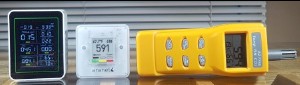
Left to right: Lwyinp, Aranet4, and AZ7755
| Model | Detector | Outdoor | Kitchen | Garage | Min.level | Connectivity |
|---|---|---|---|---|---|---|
| Lwyinp | ? | 489 ±102 | 1344 ± 1254 | 2880 ± 323 | 400 | Bluetooth |
| Aranet4 | NDIR | 438 ± 12 | 542 ± 16 | 586 ± 13 | 0 | Phone app |
| AZ7755 | NDIR | 449 ± 6 | 537 ± 18 | 602 ± 26 | 0 | Serial |
Lwyinp ten-in-one 
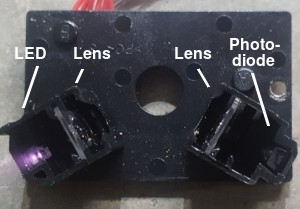
Photo of sensor optics in Lwyinp CO2 monitor. The infrared LED at left appears pink in this cell phone image but is extremely bright in an IR camera (not shown). It flashes multiple times a second. This sensor measures scattered particles
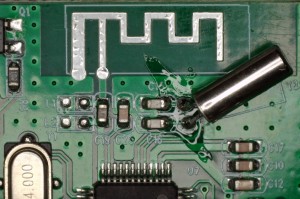
If I had known this thing had Bluetooth, I wouldn’t have taken it apart (Zig-zag structure is the antenna. A 24 MHz crystal is in the lower left)
This is a new budget monitor. It has an infrared LED + photodiode arranged at an angle to detect particles by scattering (see photo at right). The monitor claims to detect ten different parameters: three sizes of particles, CO2, air quality index, temperature, humidity, formaldehyde, carbon monoxide (CO), and time.
Positives: It’s inexpensive ($22) and it responds very quickly. It’s cute, has a bright LED display, and is very compact. The manual doesn’t overstate its specs—a good sign that they might improve it in the next model. It doesn’t like being tipped over, and loudly tells you so.
The infrared LED flickers continuously, which might be why the large 7.4 W·h battery rapidly runs down even when the LED display is turned off. That is also probably why its response time is so fast. There is no separate CO2 sensor that I could find. It looks like they’re using some clever trick to measure absorbance and scattering in the same detector, then calculating CO2 and three different particle sizes by combining signals. There is also a tiny hydrocarbon gas sensor (HGS) SMD chip on the PCB. The amount of ingenuity that goes into these things is remarkable.
Negatives: (1) It calibrates itself automatically whenever you turn it on. This means you must take it outdoors before turning it on. Even if you turn the display off, the battery gets depleted in a few hours, so you have to keep it on a USB power supply. It appeared to automatically calibrate itself at other times, though it was hard to be sure.
(2) It can’t display any reading below 400 ppm. If you calibrate it, it will set whatever CO2 it happens to see as the background, about 413 ppm. This means if you accidentally calibrate it (or power cycle it) in an indoor room, all your subsequent readings will falsely show good air quality. The other detectors below are all manual calibration, which is better, and can read down to 0 ppm, so you’d notice this mistake immediately.
(3) Its sensor is not as accurate as an NDIR sensor. It inaccurately showed over 3000 ppm CO2 in my garage. I have no idea what it was actually measuring, but it wasn’t CO2; maybe it was confusing VOCs with CO2. The other two detectors showed the correct levels to be around 600 ppm. Almost anything, even organic solvents, gives a false positive reading.
(4) The readings periodically shot up to very high levels for no apparent reason. This accounts for the high standard deviation in the readings. My unit might have been defective; recalibrating it sometimes restored it to normal. Any dirt that gets inside the optics would cause spurious readings. When CO2 goes up, CO also goes up, indicating only modest selectivity.
Conclusion: Recommended for homeowners who aren’t sure whether they need a CO2 monitor. It’s well worth the price even if all you do is take it apart so see how it works. Don’t use this in place of a real carbon monoxide detector.
Aranet 4 
This pricey one is sometimes recommended by other websites because of its higher technology display. Some people use the more advanced Pro model in industrial settings.
Positives: It is nice and compact and has an e-paper display, which means the battery lasts a long time. It uses an NDIR sensor and is highly accurate. It can read down to 0 ppm CO2, which is essential if you’re monitoring environmental chambers with subambient CO2 levels.
Negatives: To configure it or get data from it, you have to use the manufacturer’s Bluetooth cell phone app. Lots of people have trouble getting it to connect. The monitor paired easily with Android and with my Windows laptop (though they had no idea what to do with it), but no amount of tweaking could get it to pair with the app. Without it, you’re stuck with getting readings every five minutes and having no way to access them, transfer them, or clear them from memory. Collecting data with a phone is not optimal because you still have to transfer the data to a PC to use it. A Windows / Linux application is needed.
The only physical configuration is three tiny DIP switches for Auto / manual calibration, °C/°F, and Bluetooth on/off. The Pro model can connect to Aranet base stations. A tiny tool for setting the switches comes with it. Unless you tape that tool down, it’s about five seconds before it gets stuck in your foot.
Conclusion: If you get this one, you’re taking a gamble. It’s probably great if you can connect to it. Be sure you’ll be able to send it back; the company is helpful but they can’t fix their software for you. Buy it if all you need is a visual display for your nightstand. There’s no light on it, so you’ll need a nightlight for it. A Lwyinp may be a good choice for this.
AZ7755
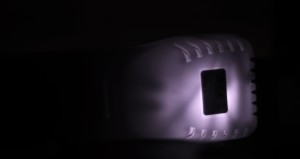
Infrared photo of back of AZ7755 CO2 monitor. The IR LED is visible through the sea of oranginess and flashes every four seconds
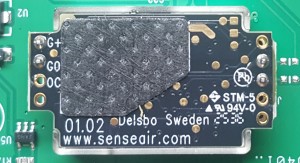
The S8 NDIR sensor 004-0-0053 in the AZ7755 is mounted face-down on the daughterboard
This intermediate-level monitor is big, it’s orange, it’s plastic, and it’s ugly. It uses a dim LCD screen with a green LED on the side instead of a backlight. The only way to get data from it is through a 1/8-inch phone plug marked RS232. The monitor sends text data out this serial port every two seconds. If the term ‘9600-8-N’ is familiar to you, recording this text will be like falling off a log—at least for us oldies. If you’re a Gen-Z’er, look up “terminal emulator” and weep for the good times you missed.
The manual says normal ambient fresh air is 380–420 ppm, which should give you an idea how old it is. But sometimes old is good. This is the one I pick up when I want to measure a room.
The extended gray part on the top is not the CO2 sensor. It contains humidity and temperature sensors that are essential in correcting the readings. The infrared flashing light comes from a small rectangular NDIR sensor on a daughterboard behind the LCD screen. The sides of the sensor are transparent, which accounts for the visible flashing, but the top is covered with a black pad that acts as a diffusion area. The meter relies on the ability of polypropylene to absorb mid-IR light. If you take it out of its case or obstruct the vents on the top it registers an inaccurate value.
The sensor is rated 400–10,000 ppm, but I verified that it reads down to at least 250 ppm. (The datasheet says not do to that, but who pays attention to those things?) It has an algorithm called Automatic Baseline Correction that corrects for long-term drift due to mishandling. Recalibrating it sounds like a royal pain.
Positives: It is as accurate as the Aranet4, and like the Aranet it can read down to 0 ppm CO2. It is dead simple to use. And because it’s so much bigger and orangier, you’re unlikely ever to lose it. It takes a reading every 4 seconds (not every second as it claims). This is still 15 times faster than the Aranet, if you can get the Aranet app to work (75 times faster if not), though as with all NDIR-based detectors, it will take a couple minutes to reach a plateau value.
Negatives: The only problem is that it doesn’t want to be turned off.
Conclusion: This is the one I use all the time. It is a tank, and no badly written apps are needed to make it work. You can always buy an RS232-to-USB converter if your PC lacks a serial port.
oct 08 2026