rtificial intelligence has always been a great way to render information
untrustworthy. So what happens when we ask it to design new viruses?
rtificial intelligence has always been a great way to render information
untrustworthy. So what happens when we ask it to design new viruses?
A recent paper asked that question. The article is paywalled and it rapidly disappeared from Science’s main page, which means that the editors recognize its limitations.
The authors used two chatbots called Evo 1 and Evo 2 to create mutated versions of an E. coli phage called ΦX174, a phage commonly used in evolution experiments. They created thousands of candidate DNA sequences and synthesized 300 of the most promising ones. Only 16 were actual viable phages. The authors say they found that a “cocktail,” i.e. an unknown mixture of the products, was partially able to overcome ΦX174 resistance in bacteria. They say this as if it was an achievement, but what it really means is the product was no longer similar enough to ΦX174 for the bacterium to recognize it. In other words, their “AI” program took a perfectly good phage, proposed mutations on it, and turned at least 95% of them into slop.
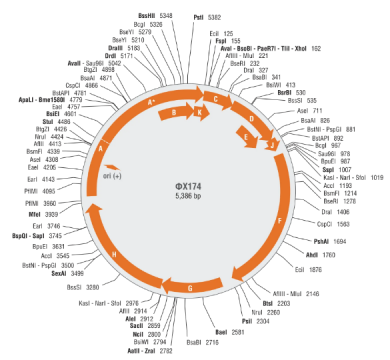
Phage ΦX174 map showing the restriction sites. The user’s DNA is inserted in a restriction site. The orange circles are the 11 gene products, many of which are non-essential. The origin of transcription (Ori) is in A. Source: New England Biolabs
What is a phage and why would we want new ones?
Although plasmids and phages (aka bacteriophages) have similar names, they are not the same. ΦX174 can refer to the plasmid, which is a small circular DNA, or to the complete phage itself, which has both DNA and proteins. Creating new viruses, plasmids, and phages is routine; they are essential tools in many biology labs. The plasmid is usually given an antibiotic resistance gene or a fluorescent tag that makes it easy to isolate. Phages are also easy to isolate because they will kill the bacteria on a Petri plate.
Phages are potentially valuable because as conventional antibiotics continue to lose their effectiveness, phage therapy will likely replace antibiotics. Phages are being considered for urinary tract infections, ulcers, respiratory infections, post-transplant infections, multidrug resistant bacterial infections such as MRSA, and for eliminating harmful bacteria from food. Since human cells lack the receptors needed for efficient phage uptake and because phages are rapidly attacked by our innate immune system, phages are relatively safe for humans. For the same reasons they would not likely be useful for treating cancer.
Why use AI if anybody could do it?
Most DNA vendors have software that allows you to select the various parts of a plasmid: you tell it the start codon you want, select the linker sites and antibiotic resistance gene you want, then paste in the sequence you want to test. There’s almost no need to mutate individual bases anymore. It’s something a first-year biochem student could do.
The paper was mainly a proof of principle. It was a nice demonstration that a chatbot doesn’t necessarily need words but can work on nucleotide bases. But it also goes down the same path that “AI” has taken: taking perfectly useful information and turning it into junk. The starting phage already worked: if the chatbot had done nothing at all, the result would have been between 18 and 128 times better.
Why only 16 ‘new’ viruses?
ΦX174 is known to have large regions that are unnecessary, so it is hardly surprising that mutating it could still leave behind a viable phage. What is surprising is that the chatbot only created a small number of them. If the goal had been to make viable phages, and if it was really AI, it could easily have succeeded. What the authors apparently wanted was to see if a chatbot would work better at generating mutations than a five-line Python script you could write in five minutes.
Another possibility is that it was a stunt designed to panic people into passing laws against AI. Since AI doesn’t yet exist, that would be like passing a law against time travel. Or—my theory—maybe they just forgot to edit out all the extra em-dashes the chatbot added.
It’s tempting to dismiss it as more fake news like those tabloid stories that say “WW3 fears explode” and “Panic in Russia!“; and indeed one now says “Panic as AI creates never-before-seen viruses—risk of ‘serious harm’.“ But in fact it’s an example of how researchers like to try out new techniques to see if they work. And by ‘work,’ as usual in science it means getting a publication out of it.
It’s worth remembering that the software has no idea what any of this means. Like the AI at some company that supposedly went berserk and started hacking into their competitors’ systems, what they’re calling AI is just another computer program. It knows nothing, it decides nothing, and it creates nothing. There’s zero chance of consciousness or even rudimentary awareness ‘emerging’ from it. While someone could theoretically use it to create deadly new diseases, doing it this way would be very inefficient: even the Wuhan Institute of Virology had to start with a bona fide disease virus and use conventional techniques to increase its tropism, species selectivity, and pathogenicity.
The authors describe it as a new computational technique like a genetic algorithm. The claim is that a chatbot is a simple technique for producing mutations that can be used for directed evolution. And indeed, it’s a promising new tool for studying evolution. So far it appears to have the random mutation part down cold. For generating novel antibiotics, not so much.
aug 09 2026, 5:38 am. updated aug 10 2026. edited for clarity aug 12 2026