new paper
in eBioMedicine claims that sodium bicarbonate, aka baking soda,
reduces the risk of dementia by 51%. [1]
new paper
in eBioMedicine claims that sodium bicarbonate, aka baking soda,
reduces the risk of dementia by 51%. [1]
The authors correlated a variety of drug treatments given to patients with the onset of Alzheimer’s disease and related dementias, or ADRD, which includes vascular dementia but typically mostly means AD itself.
Even though eBioMedicine is a Lancet journal, this is a reasonably good paper. It was an observational study from a large database. This means they had a large N (24,855 with ADRD). However, 57% of the groups had some imbalance, the specific type of dementia was not broken out, and the results are only statistical correlations. The 24,855 patients were spread across 181 drugs, so on average it would be 137.3 dementia patients per drug, plus a lot more controls without dementia. To make it more convincing, we would also need two more things: A biochemical mechanism to explain what the drugs are doing and a placebo-controlled clinical to show cause-and-effect.
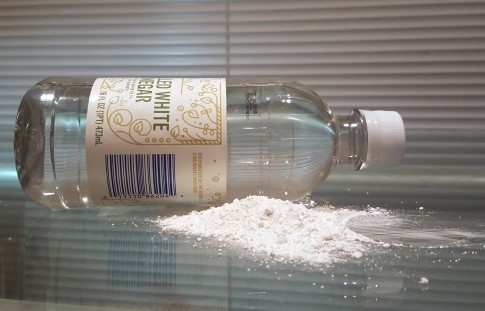
Vinegar and baking soda, not necessarily a treatment for dementia
Querying large databases is how a lot of research is done these days. If you propose doing MRIs, for example, they won’t fund you. They’ll say there’s a big MRI database out there, just use that. You can’t compete; as with a GWAS (genome-wide association study), you get a bigger N than your lab could ever afford. It’s a good way of getting clues but not the best way of doing science because you always get an answer from a database, but not always a correct one.
Most people think of sodium bicarb as that powder you pour down the sink with vinegar in the belief that it will unclog your drain. That’s obviously not what it’s doing here, but there is still ambiguity: Is it the sodium or the bicarbonate that is having an effect?
Baking soda is different from washing soda, which is sodium carbonate; and Bon Ami, which is calcium carbonate. Ingesting either of them would be very harmful. All drugs have side effects, sometimes lethal ones, so just taking one or more of the drugs in this study out of hope would be a very bad idea.
Repurposing
Drug repurposing is a way of skipping the expensive clinical drug trials and lengthy FDA approval process. It is sometimes risky and often leads researchers down the garden path. If it works, it can bring a lifesaving drug to patients much quicker.
The findings
The authors used the Benjamini-Hochberg procedure to control the false discovery rate. This is an essential step because testing large numbers of hypotheses always leads to spurious correlations.
The main finding is that 20 drugs seemed to dramatically reduce the incidence of dementia by about 50%. They are:
Anti-inflammatory drugs dexamethasone, methylprednisolone, prednisone, and NSAIDs celecoxib and ketorolac, each reduced the incidence by over 50%. Also gabapentin and pregabalin had some effect.
Antibiotics cefazolin, clavulanate, and fluconazole (an antifungal agent)
Adrenergic agonists tizanidine, propranolol, epinephrine, salmeterol
Metabolic drugs and hormones spironolactone (a diuretic), ezetimibe (Zetia, a cholesterol absorption blocker), empagliflozin, famotidine, estradiol (used in female hormone replacement therapy), and sodium bicarbonate (used to balance pH and unclog drains).
So what we have here is the pharmacological equivalent of a GWAS. The authors try to justify how the drugs might work, but they can only speculate. That’s the best we’re likely to get these days now that NIH has practically stopped funding basic research on Alzheimer’s disease.
A weakness of the study is that they don’t name the drugs that did not work, so it’s hard to evaluate the results. We need to see the confidence intervals and statistics for those 161 other drugs. Suppose, for instance, celecoxib works but aspirin doesn’t. That would hint that it’s a side effect and not COX-2 inhibition by itself. Now somebody else has to test them both to find out.
Alternative interpretations
The subjects were patients who were given the drug as part of their treatment for something else. So if the results are true, it could mean one of three things:
Those conditions (inflammation, pain, bacteria, etc.) are potential risk factors for dementia because treating them prevented dementia.
The drug worked, but the effect on dementia was an unexpected side effect.
The diseases themselves actually protect against dementia and the treatment was just a ‘witness’.
This last one is not so far-fetched as it sounds. Cancer is known to prevent Alzheimer's disease. Whether it is the treatment that patients receive, the immune response to the disease, or, as some people think, an inherent imbalance between cell growth and senescence, is not known.
These results don’t say eating bicarbonate of soda will prevent dementia. At best it’s a clue that dementia patients might have some metabolic condition that upsets their acid-base balance. Or the disorder could prevent absorption of some essential nutrient. If so, the drugs don’t necessarily have to cross the blood-brain barrier to work. It’s worth mentioning that celecoxib failed in clinical trials years ago and results with prednisone were not encouraging. Steroids can cause psychiatric symptoms in Alzheimer patients.
The observation that people with gingivitis have a higher incidence of AD is a good example of the need to separate cause and effect. Does bacterial inflammation cause dementia, or do people with dementia forget to brush their teeth? Nobody knows.
In a worst-case scenario, a drug might kill the patients. This is a well established, sure-fire way to protect them against dementia (this is related to ”immortal time bias”). Until we know how these drugs work, patients who are not immortal should be cautious.
[1] Wu Q, Li L, Lei Y, Zhou T, Tang H, Zhang B, Lu Y, Salvatore M, Zhang D, Tong J, Wang T, Chen S, Li H, Xu Z, Huang Y, Hu Y, Hong N, Zhou Y, Lin F, O'Brien KS, Chen Y, Li R, Xu H, Wang F, Bian J, Wolk DA, Chen Y. Discovering repurposable drugs for Alzheimer's disease and related dementias: target trial emulation using decentralised real-world data. EBioMedicine. 2026 Sep 4;132:106466. doi: 10.1016/j.ebiom.2026.106466. PMID: 42697072; PMCID: PMC13572180.
oct 04 2026, 6:38 am