new paper in Nature [1] adds to the growing suspicion of lithium as a possible factor in Alzheimer's disease. That suspicion has grown over the years, and clinical trials have been underway since 2017.[2]
The new paper reports that lithium levels are reduced in the prefrontal cortex of patients who died with mild cognitive impairment (MCI) or with Alzheimer's disease (AD). They report corrected p-values of 2×10⁻⁵ or one in 50,000.
Right away there are questions. As often happens, there's a lot of overlap between the controls, called NCI (no cognitive impairment), and the patients. Secondly, hippocampus, not prefrontal cortex, is the main target of AD and it's not clear why they didn't measure it there or in the entorhinal cortex, where AD originates. (The likely reason is that everybody and his brother wants hippocampus, so they couldn't get any from the brain bank.) The authors know that hippocampus is better, of course, and it figures dominantly in their transgenic mouse experiments.
Transgenic mice are mice designed to express huge amounts of beta-amyloid, which makes them useful for tox studies. But it's been well accepted for decades that they're not a good model for AD. The rest of the paper is just another paper on the various effects of lithium on mice and we won't discuss it further.
Lithium is not believed to be an essential trace element for humans, so if the lithium theory is correct that point will have to be revisited. Note that the concentrations used for treating mania are 1000 times higher than those found here, so there's no telling what those clinical doses are really targeting.
Although the authors find lithium in plaques, this paper is actually another blow to the beta-amyloid theory. Beta-amyloid binds to copper, iron, and zinc but not to lithium except non-specifically.[3] Indeed, copper chelators failed spectacularly in clinical trials. Lithium is well known as an inhibitor of the enzyme GSK-3β,[4] which controls tau hyperphosphorylation, called p-tau for short, now accepted as a marker for AD.
Now, maybe there's something else in the plaques besides beta-amyloid that binds lithium. Maybe there's a clue there. But you're probably thinking: if there's only one viable biomarker for AD, and that is p-tau, the one thing you can't use as a marker is p-tau because you'd get a false positive result. So how would you study lithium? All you have left is cognitive tests.
Epidemiologic models
Probably every AD researcher has pored over all those epidemiological maps for clues about a possible environmental cause of AD. Many of them show statistical significance. For instance, Shi et al. claimed that PM2.5 particles in air pollution containing sulfate, ammonia, organic matter, or black carbon correlated with AD. In their PNAS paper [5] they also produced a great map of dementia and AD by US county, reproduced below.
The USGS made a sophisticated computer model based on groundwater lithium measurements at depths likely to be in the water supply. [6,7] They produced a nice map as well. There seems to be a rough correlation between low lithium (A, yellow) and AD incidence (B, blue). But the CDC has a different map for age-adjusted mortality from AD. This map (not shown) shows Washington, North Dakota, and South Dakota with highest age-adjusted AD mortality rates (44, 37, and 36 deaths per 100,000), but Hawaii, New York, Nevada, and Florida with the lowest (11, 11, 14, and 18 deaths). There is no correlation among these states with lithium: some are high and some are low.
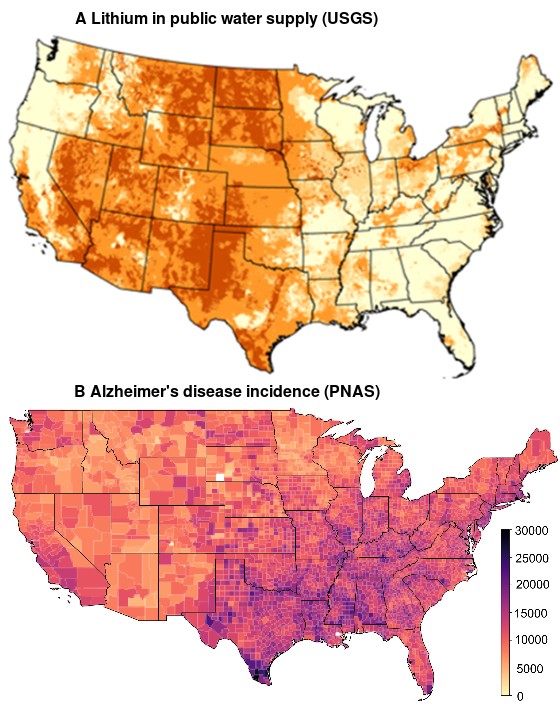
Map of lithium and Alzheimer's disease. A: Lithium concentrations in groundwater. Lombard MA, US Geological Survey [6], republished in [7]. B: Nationwide occurrence of Alzheimer's per 100,000 Medicare beneficiaries, 2000–2017. Shi et al., PNAS [5], Fig. 1B, CC BY-NC-ND
The marked differences in AD incidence and death rates shown above point strongly to an environmental source. But the discrepancies mentioned above show that county-by-county maps, no matter how beautiful, aren't always reliable. Maps can be wrong for many reasons: people can get lithium from other sources; people can move from regions of high lithium to regions of low lithium; there could be genetic or cultural differences in different states; and lithium uptake or sensitivity, rather than lithium itself, could be the true factor.
Nevertheless, the finding is suggestive. Despite the fact that Aron et al. mention beta-amyloid 56 times, it's also another death blow for the theory that just won't die. Of course it will need to be repeated using autopsy samples from more representative regions; and somebody will have to relate the results to Braak score and with other forms of dementia like FTD as possible confounding factors.
Should you take lithium to prevent AD? Sure, if you're a transgenic mouse. Otherwise, wait. By now there's no doubt that some big pharma company is developing a drug that's not only better, but also is really really really expensive. And that's the one you should nag your doctor about.
[1] Aron L, Ngian ZK, Qiu C, Choi J, Liang M, Drake DM, Hamplova SE, Lacey EK, Roche P, Yuan M, Hazaveh SS, Lee EA, Bennett DA, Yankner BA. Lithium deficiency and the onset of Alzheimer's disease. Nature. 2025 Aug 6. doi: 10.1038/s41586-025-09335-x. PMID: 40770094.
[2]Gildengers AG, Ibrahim TS, Zeng X, Aizenstein HJ, Alkhateeb SK, Anderson SJ, Chu C, Diaz JL, Emanuel JE, Karikari TK, Li J, Lopez OL, Lopresti BJ, Royse SK, Sajewski AN, Santini T, Weinstein AM, Wu M, Butters MA. The LATTICE Study: Design of a pilot feasibility randomized controlled trial of lithium to delay cognitive decline in mild cognitive impairment. Alzheimers Dement (N Y). 2025 Jun 11;11(2):e70112. doi: 10.1002/trc2.70112. PMID: 40501510; PMCID: PMC12152361. clinical trials started in 2017 [2]
[3] Berntsson E, Paul S, Vosough F, Sholts SB, Jarvet J, Roos PM, Barth A, Gräslund A, Wärmländer S. Lithium ions display weak interaction with amyloid-beta (Aβ) peptides and have minor effects on their aggregation. Acta Biochim Pol. 2021 68(2):169–179. doi: 10.18388/abp.2020_5493. PMID: 33909969.
[4] Karati D, Meur S, Roy S, Mukherjee S, Debnath B, Jha SK, Sarkar BK, Naskar S, Ghosh P. Glycogen synthase kinase 3 (GSK3) inhibition: a potential therapeutic strategy for Alzheimer's disease. Naunyn Schmiedebergs Arch Pharmacol. 2025 Mar;398(3):2319-2342. doi: 10.1007/s00210-024-03500-1. Epub 2024 Oct 21. PMID: 39432068.
[5] Shi L, Zhu Q, Wang Y, Hao H, Zhang H, Schwartz J, Amini H, van Donkelaar A, Martin RV, Steenland K, Sarnat JA, Caudle WM, Ma T, Li H, Chang HH, Liu JZ, Wingo T, Mao X, Russell AG, Weber RJ, Liu P. Incident dementia and long-term exposure to constituents of fine particle air pollution: A national cohort study in the United States. Proc Natl Acad Sci U S A. 2023 Jan 3;120(1):e2211282119. doi: 10.1073/pnas.2211282119. PMID: 36574646; PMCID: PMC9910468.
[6] Lombard, M. A. Data Used to Model and Map Lithium Concentrations in Groundwater Used as Drinking Water for the Conterminous United States U.S. Geological Survey: 2023.
[7] Lombard MA, Brown EE, Saftner DM, Arienzo MM, Fuller-Thomson E, Brown CJ, Ayotte JD. Estimating Lithium Concentrations in Groundwater Used as Drinking Water for the Conterminous United States. Environ Sci Technol. 2024 Jan 16;58(2):1255-1264. doi: 10.1021/acs.est.3c03315. PMID: 38164924; PMCID: PMC10795177. https://pubs.acs.org/doi/10.1021/acs.est.3c03315
aug 07 2025, 10:07 am