ccording to a press
release,
people are now saying that global warming
causes volcanoes to erupt. The idea is that glaciers prevent volcanoes by
pushing down on the rock, and so if the glacier melts, pressure is less and
dissolved gases are released, which push magma from deep in the earth to
the surface.
ccording to a press
release,
people are now saying that global warming
causes volcanoes to erupt. The idea is that glaciers prevent volcanoes by
pushing down on the rock, and so if the glacier melts, pressure is less and
dissolved gases are released, which push magma from deep in the earth to
the surface.
The paper isn't published yet, so we can't evaluate whatever evidence there may be. But nature is not so simple as our feeble human brains seem to think, and there's no reason to assume that melting glaciers, if that ever happens, would be harmful. They might be, as Merlin says in Transformers 5, just the thing.
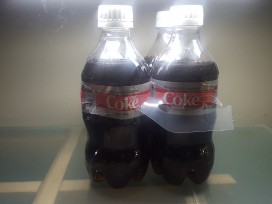
Dusty bottles of a prehistoric liquid called Diet Coke found in my pantry. These bottles expired on March 15, 2021, about the time I switched to Pepsi. They're almost certainly flat by now
Undersea volcanoes
A suppressive effect is thought to happen in undersea volcanoes. It's sometimes claimed that the weight of ocean water prevents the explosive release of steam and volcanic gases, making underwater volcanoes less hazardous. In fact, the most destructive volcanoes in history are not the slow, intermittent ones like Mount Etna. A bigger danger comes from volcanoes in which gases cannot be released but build up over long periods of time, resulting in a catastrophic explosion.
Andrei Netchayev described explosive volcanic eruptions as a variation of the gas piston mechanism, where a column of liquid erupts under gas forcing:
It is assumed that the acceleration of magma and its eruption is caused by imbalance in the contact zone of magmatic conduit and fluid layer at depths exceeding 1 km. The Superheated Fluid (may be water vapor Fluid) at the pressure greater than 220 bar and temperatures above 647 K obeys the ideal gas law. . . . If the Superheated Fluid penetrates into magma system and displaces some small part of magma to the surface, and its volume at the same time exceeds a certain critical magnitude, there is a pressure difference at the contact zone, and Fluid begins to push the magma out of the conduit like a piston.
Although some sources say the rapid expansion of gases is the driving mechanism of most explosive volcanic eruptions, the role of gas in ordinary eruptions seems to be still a minority opinion in geophysics. But it's easy to understand. Open a bottle of soda, the pressure is released, and sure enough a few tiny bubbles of CO2 rise to the surface. Shake the bottle up beforehand, and you get foam everywhere.
Drinkers of carbonated beverages will note, however, that loosening the cap for a week while it's in the fridge allows the CO2 to dissipate harmlessly, eliminating danger of violently expanding foam altogether.
Netchayev dismissed the idea of dissolved gases and described several configurations where water vapor and other volcanic gases might accumulate. In some, pressure from surrounding rock would prevent eruption. In others, it would accelerate it.
Coal mines
Built-up gas pressure is a serious threat in coal mines. Here the principal gas is methane, called firedamp, and elaborate precautions must be taken to remove it. By far the biggest danger is not the methane itself but the fact that methane combustion could ignite coal dust, which produces a more violent and rapid explosion. Because of its high surface area, rapid oxidation of coal dust produces an intense shock wave.
The problem is that no one can do actual experiments on volcanoes without incurring astronomical liability risks. The best we can hope for, if this paper is ever published, would be a correlation, making it a judgment call. And that means whether this finding gets accepted will be determined not just by evidence, but by whether it's something some funding agency wants to hear.
The biggest risk in science is that your theory might be underdetermined. There are many potential causes for any effect. The factor that one thinks is important might not be important at all. I've seen it over and over: researchers focus on one hypothesis and, convinced that the effect is unifactorial, write paper after paper documenting even the tiniest bits of evidence for their theory. They go down the rabbit hole. But if they think there's funding down there, then by God they'll do whatever they need to get it whether it's real or not. There is no more dangerous place to stand than between a scientist and his funding.
The solution: get rid of those glaciers ASAP
If these glaciers are preventing volcanoes from releasing trapped gas and water vapor (and this is a big if), they are clearly a safety hazard. The longer these gases remain trapped, the larger and more dangerous the eruption is likely to be. We must implement a crash program to eliminate those glaciers to prevent the trapped gas from building up. Even that might not be enough. We may need to drill pressure relief holes to remove the trapped gases.
Perhaps the geoengineering people should do this. They seem to be the least concerned with any potential liability.
jul 09 2025, 6:24 am