verybody is celebrating the latest news from
NOAA:
The ozone hole over Antarctica is cured! This year it’s the fifth
smallest it’s been since 1992! Woo-Hoo! Banning things works!
verybody is celebrating the latest news from
NOAA:
The ozone hole over Antarctica is cured! This year it’s the fifth
smallest it’s been since 1992! Woo-Hoo! Banning things works!
I’d expect the popular news media not to read more than the press release, but I expect better of the alternative media. One writer even seems to have gotten ‘ozone hole’ mixed up with ‘global warming.’ That’s not as crazy as it sounds: there is some research connecting them.
NASA’s figure at its Ozone watch ozone history website shows five things:
Ozone started decreasing suddenly around 1979 and remained low until the present, with minor unexplained fluctuations.
There has been no statistically significant overall change since CFCs (chlorofluorocarbons) were banned by the Montreal Protocol in 1987.
NASA’s graph is plotted incorrectly, exaggerating the size of the hole and falsely suggesting that ozone is near zero. You’d get nailed for putting that graph in a scientific paper. The graph is typical of graphs for public consumption, where the goal is to convince people, not to tell them the truth.
Several methods exist for measuring ozone, including Halley (a ground intrument), TOMS (Total Ozone Mapping Spectrometer), OMI (a European Ozone Monitoring Instrument), and OMPS (Ozone Mapping and Profiler Suite). The newer methods consistently show slightly lower ozone than the old ones.
The different methods generally agree with each other to within 10–20%. Numbers from different sites vary according to the exact dates averaged together and the trends are generally consistent with each other.
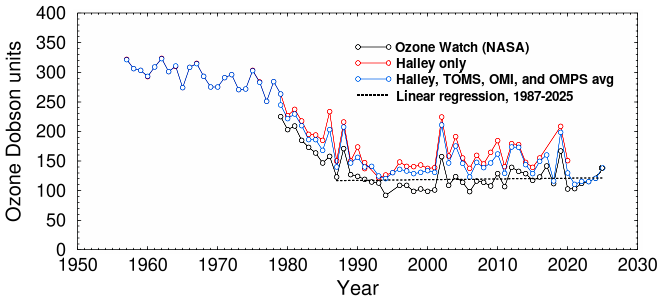
Ozone history redrawn from NOAA and NASA data. Linear regression is from the Ozone Watch data. Up = smaller ozone hole
Above is a properly drawn graph, redrawn from NASA’s figure. I included more recent numbers up to 2025.
The replotted graph also shows, as a dotted line, a linear regression of the Ozone Watch data from 1987 to 2025. It shows a coefficient of correlation of 0.078 and a slope of 0.124 ± 0.264. The slope of the line is not significantly different from zero (p = 0.642).
This does not mean eliminating CFCs does nothing at all. It’s conceivable but extremely unlikely that ozone would have gone to zero if nothing was done. But assuming for the sake of argument that the ozone hole is caused by human activity, and that CFCs were the principal factor, that curve should have been a straight line up, or at least an upward bending curve. The data show that hypothesis to be incorrect.
We’re now 38 years after Montreal. Unless the residence time of CFCs has been badly underestimated, the assumption that it was only or mainly chlorofluorocarbons is pretty much debunked.
When the ozone hole gets bigger, NOAA and the news media are silent. When it gets smaller, it’s big news and they pat themselves on the back for curing it. More than that: it sets up for the next time it gets bigger when any decrease, however small, is cause for more celebration—a ratchet effect. There is something else going on with the ozone besides CFC and the science establishment seems to be afraid that if somebody finds it, it will undermine their narrative that Montreal was a glorious success. And they’re probably right.
It’s classic pathological science: the boss or department head wants to tell a simple story that makes him look good and brings in more funding. You get a data point that seems to support it, and it’s champagne, confetti, party balloons, and press releases. You get one that doesn’t, and it must be wrong. I had to repeat one experiment eleven times to convince my boss that that one data point he liked was a fluke.
As Bub Dylan (the guy who brings me coffee) said: How many data points must a man write down, before . . . um, something. Time to go back to banging my head on the wall.
dec 02 2025, 9:58 am