nly in an age of post-truth could academia have invented a science
of Misinformation Studies. It would be one of the easiest of sciences:
all one need do is state untruths, of which there is an infinite supply.
An glorious horizon of infinite falseness would open up before us. We could
have Departments of Misinformation devoted to accumulating it. People could
get PhDs in Falseness Studies. Once delineated and categorized, we would have
cross-disciplinary studies: misinfobiology, misinfophysics,
misinfo-women’s studies, and so on, all dedicated to seeking out untruth.
nly in an age of post-truth could academia have invented a science
of Misinformation Studies. It would be one of the easiest of sciences:
all one need do is state untruths, of which there is an infinite supply.
An glorious horizon of infinite falseness would open up before us. We could
have Departments of Misinformation devoted to accumulating it. People could
get PhDs in Falseness Studies. Once delineated and categorized, we would have
cross-disciplinary studies: misinfobiology, misinfophysics,
misinfo-women’s studies, and so on, all dedicated to seeking out untruth.
Tragically, the new science seems already to have gone into decline, for it has discovered a flaw: it is inherently political, which means there is their misinformation, which is bad, and our misinformation, which is good.
What causes misinformation
First let us ask why misinformation exists at all. Often it starts as a simple mistake. Like a language that evolves in isolation, the error gradually spreads within a group and becomes incomprehensible to outsiders, thus reinforcing group identity. The falsehood becomes a shibboleth. The more counterfactual the falsehood, the more it demonstrates fealty to the group identity, and dissenters are easily spotted and cast out.
The next logical step is to believe two contradictory falsehoods at the same time. It is a tough intellectual challenge: pretending they are both true demonstrates a person’s tremendous brain power in holding two thoughts simultaneously that not only conflict but annihilate each other. As such it requires a talent for retaining nothing but decayed fragments of ideas in one’s head.
Falsehoods in science
Many instances of ‘misinformation’ result from a science writer creating a truly shitty sentence that invites misinterpretation. A good example is how a statement on Covid in Science was so badly written two guys wrote a whole book around it.
Virtually every scientific article I’ve ever read also contains some mistake. One misstated the concentration of a reagent by a factor of ten. We couldn’t reproduce their work until we discovered the error. Another time somebody misread ‘nitrates’ as ‘nitrites’ and incorrectly claimed that 80% of our intake of nitrites comes from vegetables, which are rich in nitrates. Peer reviewers sometimes force authors to include falsehoods in order to get published. And there’s always some doofus who’s so ambitious he fakes half his data and may or may not get caught.
Then there are sites like Pubpeer, where people mistakenly see data falsification, a form of misinformation, whether it’s there or not. I’ve saved papers by colleagues at two different institutions from this crap. False accusations not only create headaches for scientists and force them to practice defensive science; they also undermine confidence in science, as people in their endless quest to throw shit at each other uncritically quote questionable studies purporting to prove that some improbably high percentage of research is irreproducible.
For every scientific paper that has a figure upside-down, duplicated, or faked, there are hundreds of dull ones that study meaningless, dead-end topics. Increasingly, the tactic is to make your paper as dull and useless as possible so there’s no incentive to attack it.
The impact of this defensive science is bigger than any ‘misinformation’ can ever be. It could bring scientific progress to a halt. Scientists do make mistakes. As they say in New York, sue me. (That’s short for ‘sumimasen.’ Everyone is so polite in New York. . . .) But the term ‘misinformation’ is usually only applied to laymen because applying it to science would undermine the goal of making Misinformation Studies a respected branch of science. That goal is hard enough as it is.
Photons at the end of the tunnel
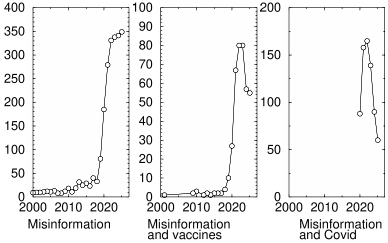
Number of publications in PubMed on total misinformation, misinformation about vaccines, and misinformation about Covid. Year 2025 data points are scaled to 12 months
The good news is that the science of ‘misinformation’ may already be dying. The number of articles on ’vaccine misinformation’ and ’Covid misinformation’ has dropped dramatically since 2023. Even the total number of articles on ’misinformation’ has tapered off at around 350 per year. This could mean that experts on misinformation are realizing that proving something false takes exactly the same amount of work as proving something true.
In a rare open-minded article, Roozenbeek et al.[1] found that generalized mistrust in government did not correlate with ‘susceptibility to misinformation.’ Only “specific distrust in the government about vaccinations” correlated with mistrust of vaccines. This makes sense: if the government pushes misinformation about vaccines, the two variables are identical and they’re automatically correlated.
Roozenbeek also points out that mushy definitions just won’t do. Defining ‘trust’ as “a person’s belief that another person or institution will act consistently with their expectations of positive behavior,” he says, is a circular definition that gets us nowhere: even Hitler thought his behavior was positive.
Demanding that people must ‘trust’ science is a way of asserting that the public has no right to evaluate the research that directly affects their lives. Indeed, no scientist worthy of the name “trusts” science. Some of my colleagues are badly trained; some are crumb-bums or liars; and even Nobel laureates make mistakes. With apologies to Reagan, we must verify, not trust: Proveryat’ a ne doveryat’.
The worst thing one could do is draw a conclusion from the abstract of a paper. These rarely represent what the data show. Sometimes they say the opposite of it.
Misinfo researchers who use terms like ‘antivaxxer’ and ‘conspiracy theorist’ want the brutal fist of government to enforce the idea that whatever they think is true must never be challenged. Many go even further. One [2] created a long conspiracy theory intended to provide support for the idea that President Trump is a ‘threat to democracy.’ Regardless of what you may think of Trump, this is clearly a premise not amenable to scientific proof. The ref list in that paper is a smorgasbord of dozens of similar political rants masquerading as science. This represents a failing of the journal editors to maintain the credibility of their journal. The failing includes some top science journals.
Engage the skeptics and heed their wisdom
Skeptics are not dummies. They saw how scientists deliberately ran clinical studies during Covid that were designed not to test a hypothesis but to discredit treatments they thought were being promoted by their political enemies. They saw how a researcher who claimed to find a simple and effective treatment was driven out by a suspiciously convenient scandal. So skeptics speculate as to what the truth might be. For that they get called conspiracy theorists.
Global warming skeptics aren’t uneducated rejectionists, either. Many are well informed and dedicated to correcting popular myths. Most concede that the planet might be warming. Virtually all agree that CO2 is increasing but say it is likely to be multifactorial or inconsequential. Likewise, vaccine skeptics rarely reject all vaccines; most question whether the mRNA in the Covid vax was adequately tested and dose-controlled, or they wonder how safe the enormous number of vaccinations at early ages now demanded by the CDC may be. These are reasonable concerns.
Even if some layman misses a technical subtlety, it shows they’re interested enough in science to ask the question. The science-induced catastrophe that gave us Covid ironically stirred their interest in science. That is something scientists have wanted for years. If they make a mistake, it is a teaching opportunity. If we teach that science is unchallengeable dogma, they’ll respond with their own dogma and even dishonesty. If we show how science can be open-minded and that they are welcome to participate, they’ll learn that instead.
Science is built on shifting sands of uncertainty and reversal. That is its strength. Failed theories like the Ptolemaic theory, phlogiston, and the ether were discarded because the only thing more satisfying to a scientist than disproving a false theory is finding a better one. If the drive to eliminate heresy by calling it misinformation succeeds, it will render science sterile and ultimately discredit it, and only the misinformation will remain.
[1] Roozenbeek T, van den Berg C, Lambooij MS, van der Linden S, Maertens R, Ferreira JA, van Dijk M, Roozenbeek J. Trust in institutions and misinformation susceptibility both independently explain vaccine skepticism. Sci Rep. 2025 Oct 28;15(1):37655. doi: 10.1038/s41598-025-21452-1. PMID: 41152371; PMCID: PMC12569172.
[2] Lewandowsky S, Ecker UKH, Cook J, van der Linden S, Roozenbeek J, Oreskes N. Misinformation and the epistemic integrity of democracy. Curr Opin Psychol. 2023 Dec;54:101711. doi: 10.1016/j.copsyc.2023.101711. Erratum in: Curr Opin Psychol. 2025 Oct;65:102072. doi: 10.1016/j.copsyc.2025.102072. PMID: 37944324; PMCID: PMC7615327.
nov 23 2025, 6:48 am