hy do these things keep happening in science? The biggest science story
this week was not some amazing discovery, but yet another sad tale about
something published in a top journal that was wrong and wasn’t caught during
peer review. We now know that the microplastics story was overstated,
maybe vastly so.
hy do these things keep happening in science? The biggest science story
this week was not some amazing discovery, but yet another sad tale about
something published in a top journal that was wrong and wasn’t caught during
peer review. We now know that the microplastics story was overstated,
maybe vastly so.
Science mag may be setting the tone. One editor writes:
This is a tricky area, because you don’t want to see legitimate scientific criticisms used by various yahoos to proclaim that the whole idea of microplastic contamination is bogus.
I’m sorry. Calling skeptics dirty names won’t work this time. What we had here was a classic feeding frenzy driven by bad science. We’re fairly confident that microplastics exist and they they could potentially be harmful. Everything beyond that was always ‘soft.’ There’s no other way to say it: all the research on microplastics needs to be repeated, this time with adequate controls, so we can know what is true and what is not true.
Nature’s strategy seems to be to keep the issue behind their paywall. At least they’re consistent: after their role in the Covid origin coverup, we’ve come to expect them to circle the wagons.
Political name-calling and cover-ups are the last thing science needs. Science’s credibility depends on its willingness to tell the truth no matter which side benefits, and to admit its mistakes. We should have learned this from Nixon: the cover-up is worse than the crime.
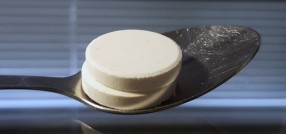
These two chewable vitamin C tablets weigh 6.302 grams, the same as the amount of plastic the Nat Med paper claimed is in your brain. The tablets are 1 inch in diameter
The centerpiece of the scandal is that paper by Nihart et al. in Nature Medicine [1] (Author corrections) claiming that the human brain contains a ‘teaspoon’ full of plastic (discussed in more detail here). By this they meant 6.3 grams per 1300 cc brain, or 4917 μg/ml. This works out to a highly implausible claim that the brain is 0.48 percent plastic.
Anyone who studies the brain would immediately recognize what must have happened: The authors misinterpreted artifacts of sample preparation as evidence of pathology. Several other papers on microplastics have also come under suspicion.
The only thing Science seems to care about is whether their political enemies will pounce on the finding. They need not worry: from reading both left-wing and conservative discussion boards, both sides seemed equally convinced that microplastics were a health problem. The “yahoos” exist only in the minds of Science editors.
Having started my research career in environmental chemical toxicity (working for a very careful researcher, I should add), I can safely say that much of the science in that field is now so bad that skepticism is warranted whenever a new paper comes out. It’s like crying wolf. What happens when something real is discovered? We know the answer from seeing the tenor of the discussion of the Covid vax, fluoride, and MMR vaccine schedules. When the science establishment suppresses debate, people speculate on the reason for it and it becomes political.
How does this happen?
Two years before the Nat Med paper appeared, I found similar particles in my own experiments with brain autopsy specimens. We’d carefully weigh the frozen brain slices, homogenize them, and add them to our cultured cells. The idea was that since the disease we were studying started in one brain region (called the entorhinal cortex) and spread to others, there could be a transmissible agent that carried it from one part of the brain to another.
Instead of biochemical changes, I’d see particles, lots of them. At first it seemed like a positive result. I spent two days investigating it and discovered that they were not coming from the brain extract. They were not contaminants from the reagents, wool from the lab assistant’s sweater, dirt from the ventilation system or the water, or a transmissible disease agent. They were not present in any of the plasticware or the solutions. They were coming from the filters we used to sterilize our solutions. Whenever we filtered something, even water, the particles showed up. I was unable to find any syringe filters from any vendor that worked without contaminating the sample and had to abandon the experiment.
It’s a lesson that experienced researchers need to pound into their students. Controls need to be done not just on the lab supplies and chemicals, but on all combinations of them used in the experiment. The composition of the microparticles in the Nat Med paper (nitrocellulose, nylon, cellulose acetate, and so on) was the same as the plastics used to filter solutions. The explanation is simple: the authors did not do the controls and created a public health panic over nothing.
Unexpected things can happen with chemicals as well. We once made a solution of SDS (sodium dodecyl sulfate, a detergent) in tap water when our water purifier broke down. Bad move. The detergent complexed with trace iron in the water, forming an insoluble precipitate. Within minutes it turned cloudy and useless.
Other critics pointed out that the sample preparation method for mass spectrometry converted fats (which are normally highly abundant in the brain) into plastic-like materials, so their analytical results were also likely compromised.
These mistakes are common with inexperienced researchers. Ten years earlier we had a postdoc who insisted that he had found ‘clumps’ or big particles in skin cells, called fibroblasts, from patients. I looked at his protocol and noticed instantly that he had forgotten to filter his bovine serum, which always forms visible clumps called cryoprecipitates when it’s frozen. This is essential, I said, even if the serum was originally sterile.
He yelled at me indignantly and I just shrugged my shoulders. A few years later, he and his boss started a company to build a clinical diagnostic tool around it. The test fell apart almost immediately. They probably wasted a couple million dollars and years of fruitless effort on an obviously wrong result.
I could mention many other times a student got excited over some artifact that showed up in their data. It’s a tough decision: you have to train them to be critical, but not so much that they get discouraged. But the one thing you cannot do is hush it up because you’re afraid those imaginary “yahoos” (and we all know who the editor means) will criticize you.
Researchers often dislike running controls. But controls are your attempt to disprove your conclusion. They are also a way of establishing causation. Treating them as a mere formality exposes you to humiliation and ridicule.
Why don’t the peer reviewers catch it?
Why don’t the peer reviewers catch these things? The answer is that peer review is not the rigorous scrutiny it purports to be. Usually the lab chief or PI waits until the day before the review is due and then hands it to a postdoc or student to review “by tomorrow.” The student, pressed for time, intimidated by the bigshot authors, and probably struggling to understand the paper, misses the flaws. The lab chief, chatting on his cell phone at the golf course, takes credit for the review and the author is forced into educator mode.
Those bad microplastics papers will probably be retracted and the idea of microplastics toxicity will have to be re-evaluated. If any good comes from this, it is that we’ll no longer be bombarded in the media with those fake pictures of somebody’s hand carrying a pile of ground-up colored bits of plastic, as if that’s what microplastics look like. But calling it an example of the self-correcting aspect of science would be too kind.
[1]. Nihart AJ, Garcia MA, El Hayek E, Liu R, Olewine M, Kingston JD, Castillo EF, Gullapalli RR, Howard T, Bleske B, Scott J, Gonzalez-Estrella J, Gross JM, Spilde M, Adolphi NL, Gallego DF, Jarrell HS, Dvorscak G, Zuluaga-Ruiz ME, West AB, Campen MJ. Bioaccumulation of microplastics in decedent human brains. Nat Med. 2025 Feb 3. doi: 10.1038/s41591-024-03453-1. PMID: 39901044.
jan 17 2026, 8:51 am