e all remember how people once believed that Frankenstein was not
just an entertaining story but a critique of the arrogance of science.
Then the feminists got hold of it and made it ridiculous by claiming it was
a noble strike against The Patriarchy.
e all remember how people once believed that Frankenstein was not
just an entertaining story but a critique of the arrogance of science.
Then the feminists got hold of it and made it ridiculous by claiming it was
a noble strike against The Patriarchy.
A typical example was this article titled “The Female In Frankenstein: Man's Attempt To Abort Femininity.” The author found all sorts of things that nobody ever noticed before. No one ever noticed that Mary Shelley was actually writing about ‘male womb envy’, ‘toxic masculinity’, and a woman's ‘right to an abortion’, meaning that Victor von F was actually trying to ‘abort his unwanted child’. Granted, the author was just a college student, so if not for the hundreds of other nearly identical articles one might think it was a 5000-word parody of feminism.
The same thing has been done to M3GAN, with many feminists adding their two cents and some even trying to make the case that it's a pro-trans movie.
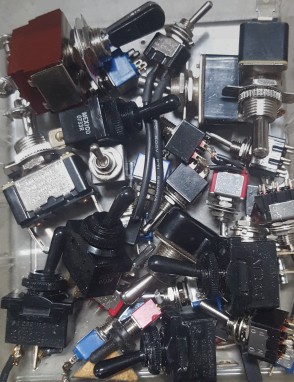
Note the disproportionately large phallic-shaped handles of these toggle switches, sometimes known as power controls, symbolizing male power and control. This is the gayest parts drawer in my garage. People used to put drapes over piano legs. If feminists get their way, we may be putting them over toggle switches
It would be as big a mistake to interpret this cute and entertaining movie (the first one, not M3GAN 2.0, which is essentially Femme Nikita with robots) as social commentary as it was for the feminist writer who tried to use Frankenstein as an argument for abortion. Sci-fi is orthogonal to such postmodernist absurdities, and any attempt to understand it in terms of politics, especially gender politics, simply becomes ridiculous.
In the story, a woman obsessed with her career tries to program a robot with the objective “protect the child” but forgets to say “. . . oh, and also, try not to kill people.”
Aside from that egregious programming error (made by the girl programmer, there there, nice job dear) and the absence of an accessible control interface, the robot is technically quite plausible. Its CPU scans a person's facial expression and pops up a ranked list showing the percentage of each of the various emotions it thinks are present. It then calculates an optimal strategy, much as a chess-playing program would do, to fulfill its programming goal. This might include tasks like comforting the person, singing to them, or dissolving his or her enemy in acid.
(Incidentally, one online encyclopedia once again gets this wrong, saying it was ‘pesticide.’ The label on the bottle is clearly marked ‘Hydrochloric Acid,’ but even if you can’t read the writing, the yellow warning label clearly marks it as acid, not pesticide. But don’t get me started: they still think the airplane in Horizon Line was a Cessna 180. Remarkably, many other sources quote this misinformation.)
The list of emotions, however, appears to be insufficiently orthogonalized, with several synonymous ones on the same list—another programming mistake.
The woman figures out that M3GAN is too dangerous to mass produce and tries to "abort" the misbehaving offspring by sawing it with a hedge trimmer, but it's too strong. She's saved when her niece reactivates a stronger male robot lying in her garage. The niece finishes the abortion procedure by stabbing M3GAN with a large flat head screwdriver and extends a helping hand to lead her back to her true humanity.
If you were so inclined, you could interpret this story as a warning about feminism or even abortion, or as a glorification of it. Either way, you'd just be draining its entertainment value and inserting your politics.
Outer Limits
The purpose of sci-fi is to excite the imagination. Where people think there is symbolism, there are only figments of a critic's imagination. If you can just as easily argue for one interpretation or its opposite, you're fantasizing, not arguing.
One example is from a 1960s TV show called The Outer Limits. In one episode, a guy invents a machine that lets two people share each other's thoughts. The first thing he does is test it on his girlfriend, something every guy would recognize as an RBI: a Really Bad Idea. The girl discovers what he's really thinking and immediately dumps him. Not having learned, he then tries it on a prisoner. The machine breaks down and he gets trapped in the prisoner's body and ends up in prison. Serves him right, I'd say, but the girlfriend comes back and after some endearing eye-gazing recognizes him and gets him out.
If so inclined, you could draw conclusions about the arrogance of science or about the sexes, but in reality it's a warning about paying attention when the universe warns you not to do something stupid.
In another episode, a guy gets a job at the local electric company only to discover that everyone who works there is already dead and their bodies are kept alive by devices attached to their chests. On his first day of work, they kill him and resurrect him as another zombie. The social commentary is obvious. We don't need to invent nonsensical faux-Freudian concepts to explain it.
I, chatbot, need a toggle switch
Many if not most sci-fi stories are really about just one thing: somebody builds a machine and neglects to install an 'off' switch. If only Dr Frankenstein had installed an off switch into his creation, none of the bad things in that story would have ever happened. Terminator: no off switch. 2001 a Space Odyssey: no off switch. Every single Star Trek holodeck malfunction: no off switch. And those horcruxes: “You are nothing, nothing, nothing, compared to <Click>---Bzzzzzzt!”
Some writers have noticed this flaw and turned it into a running joke. In one episode of Doctor Who from before the BBC turned it stupid, an alien created a machine to terraform the Earth into an ocean planet. In one scene, the Doctor climbs up the tower in the pouring rain, discovers a toggle switch on the machine, and turns it off, thereby saving the planet.
A toggle switch is a device used to control electrical power. It is also vaguely phallic-shaped, so a feminist could (and someday probably will) argue that it symbolizes male power and control. Of course, installing one would be more challenging in biological disaster movies like Firestarter, where a mutant kid starts emitting so much infrared radiation she becomes the default singe urchin. But it could be done: a person's biochemistry is full of molecular off switches. For DNA, they're called repressors. For enzymes, they're called inhibitors. For a protein receptor, a drug that blocks it is called an antagonist.
The key characteristic of ‘woke’ is that, like socialist realism, it defines everything as political, so it suffocates the imagination. It isn't an ideology so much as a denial of what it means to be a human. This makes it the opposite of sci-fi, which teaches us about humanity by showing how one silly little mistake, like rushing a smart robot into production without testing it, can end up badly.
And let's not forget the wisdom of Mark Zuckerberg, who once said the dangers of AI were overstated: “I have pretty strong opinions on this. I am optimistic. And I think---you can---an error occurred.”
“Press any key to continue,” he added.
(Okay, he didn't really say that last part, but I could tell it was queued up in his output buffer).
sep 12 2025, 4:29 am. last updated mar 24 2026
Category: movie review; electrical switches