his week Nature mag has an article titled “Major issue:
how corporate carbon emitters help to fuel more than 200 heatwaves”
(paywalled) describing a paper that says global warming could cause some
problem in the future, specifically heat waves. Sadly it's likely to remain
unnoticed among the other
126,791
papers that say the same thing.
his week Nature mag has an article titled “Major issue:
how corporate carbon emitters help to fuel more than 200 heatwaves”
(paywalled) describing a paper that says global warming could cause some
problem in the future, specifically heat waves. Sadly it's likely to remain
unnoticed among the other
126,791
papers that say the same thing.
The authors' goal is to prove, using statistics, that specific big oil companies and cement producers are causing global warming. The goal seems to be to provide ammunition for climate activists to attack them by filing enormous lawsuits in the hopes of bankrupting them. The authors say [1] there is a new scientific field called “extreme event attribution,” or EEA, which is a way of attributing extreme events to global warming, circumventing the problem of generations of atmospheric physicists insisting that you can't attribute extreme events to global warming.
Here is their founding assumption:
It has been proven unambiguously that anthropogenic activities are largely responsible for climate change and that combustion of fossil fuels is the main contributor.
If that were really true, they could just print “QED” and have the shortest Nature paper in history. But sadly it's not, so they try to do statistical analysis from selected geographical regions where heat waves supposedly occurred to prove it.
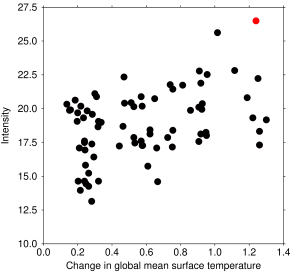
Fig 1 Replot of fig.1b in Quilcaille et al. The red dot is the heat wave in the US Pacific Northwest. Each black dot is the Intensity, which means average temperature in some previous year during the same time period, i.e. when no heat wave was occurring
First they plot ‘intensity’, which is the temperature in the heat wave, against change in global mean surface temperature (GMST, which they say has increased by 1.3° since 1850–1900). You might think getting a significant correlation by plotting the same variable against itself would be like shooting fish in a barrel, but evidently it's not; in fact, there's almost no correlation at all, and there's no good explanation why heat waves in earlier years aren't considered. We must assume they were dropped because they wouldn't support the authors' model.
For instance, in the US Pacific Northwest, they say the 2021 heat wave increased its intensity by 4.4°C compared with the average temperature on those exact dates between 1850–1900, with a 95% confidence level. From this, they get a ‘probability ratio’, which is calculated from the change in intensity and how many times more likely the event has become.
Without the upward-pointing red line through the data points (removed in Fig 1 at right) the correlation looks less convincing, though it is statistically significant. The authors admit that the reporting of heat waves is rife with selection bias, with only 9 out of 226 coming from Africa, Latin America, and the Caribbean, where heat waves usually occur. The criterion for a heat wave is not meteorological or thermal but based on its ‘reported impact’, making it easier to pick heat waves that fit their desired criteria.
One challenge in interpretation here is that if global temperatures were increasing over a given period, any event that happened toward the end of that period would appear to correlate with it. Another challenge is that ‘heat wave’ is poorly defined. EM-DAT, which is where their data came from, defines it as:
A period of abnormally hot and/or unusually humid weather. Typically, a heat wave lasts for two or more days. The exact temperature criteria for what constitutes a heat wave may vary by location.
In other words, a “heat wave” could be a mildly warm day in one location, a slightly damp day in another, and a slightly less cold day in another. An example is their Fig. 1D showing a gerrymandered area in north and east India, where a 2016 (or 2022, they give two different years) heat wave was an increase from 31 to 32.3°C (87.8 to 90.1°F, just over two degrees F above normal). (As most people know, India is often hot.)

To connect it to temperature, they use Granger causal inference, a controversial [2] statistical test invented in 1969 that purports to get around the fact that correlation does not prove causation.
Granger's original paper [3] is interesting, but suffice it to say no amount of playing with power spectra can make the impossible happen. The difficulty with Granger's method was shown when Sheehan and Grieves [4] used it to show that the US gross national product caused sunspots. The scientific method, i.e. modus tollens—intervene in the process and measure the result—remains the only universally accepted way to prove causation. Can't do that? Sucks to be you, but you can't just jump over that chasm.
So, it turns out that if temperature is increasing, the temperature in a heat wave and the number of heat waves, defined as periods of increased temperature, will also increase.
The authors went to a lot of trouble to prove this tautology. Maybe they hoped that publishing something mind-numbingly obvious would bring the two sides together. There's something on which skeptics and warmers can all agree: you can never have too many tautologies.
[1] Quilcaille, Y., Gudmundsson, L., Schumacher, D.L. et al. Systematic attribution of heatwaves to the emissions of carbon majors. Nature 645, 392–398 (2025). https://doi.org/10.1038/s41586-025-09450-9 https://www.nature.com/articles/s41586-025-09450-9
[2] https://pmc.ncbi.nlm.nih.gov/articles/PMC10571505/ Shojaie A, Fox EB. Granger Causality: A Review and Recent Advances. Annu Rev Stat Appl. 2022 Mar;9(1):289-319. doi: 10.1146/annurev-statistics-040120-010930. PMID: 37840549; PMCID: PMC10571505.
[3] Granger CWJ. 1969. Investigating causal relations by econometric models and cross-spectral methods. Econometrica 37:424–438 https://jeti.uni-freiburg.de/studenten_seminar/stud_sem_SS_09/grangercausality.pdf
[4] Sheehan RG, Grieves R. 1982. Sunspots and cycles: a test of causation. South. Econ. J 48:775–777
sep 12 2025, 4:31 am. minor edits sep 13 2025