very so often, some religious person comes up with a new argument
why God must exist. Ross Douthat has a book
on it, and sociologist Charles Murray has a new one.
very so often, some religious person comes up with a new argument
why God must exist. Ross Douthat has a book
on it, and sociologist Charles Murray has a new one.
I can’t get too excited about either one. I congratulate Murray on his newfound good fortune if it gives his life meaning. It’s fine to believe or not believe in a deity, as one chooses. But whichever you decide, you won’t convince skeptics if you do it for a bad reason. If you declare victory over ‘the atheists’ as if the creationist wars are on again, as some commentators are doing, you’ll probably drive them away for good.
The problem with using arguments to prove the existence of God is that none of the dozens of arguments invented over the last thousand years has ever worked. Not only are they logically flawed, but respected theologians like Paul Tillich have concluded, in my opinion quite reasonably, that trying to prove the existence of God using logic is pointless because God is the ground of existence, which is beyond the reach of logic.
Tillich wrote:
[T]he question of the existence of God can neither be asked nor answered . . . the answer—whether negative or affirmative—implicitly denies the nature of God. It is as atheistic to affirm the existence of God as it is to deny it. (Systematic Theology, Vol.1, p.237)
Tillich seems not to be well known among religious conservatives. That’s a shame, because his ideas are highly sophisticated. Religious people would have better success by following Tillich than by continuing to use variations of long-discredited arguments.
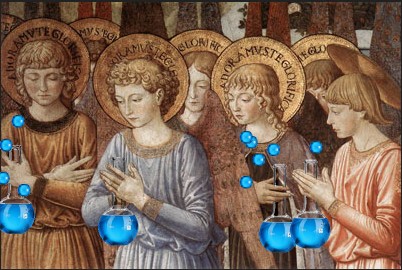
Virtuous saints doing chemistry, a modern update to the famous religious painting
The most famous bad argument, maybe the worst bad argument ever as Trump might say, was that evolution or “Darwinism” must be wrong because it contradicts the literalist interpretation of the Bible. That led some Christians to demand the teaching of “intelligent design” —a euphemism for a creator god, not mentioning any names of course—in biology classes, which set off a nasty battle with atheists who saw it as imposing religion on their children.
Proteins popping into existence
After decades of bitter arguing, both sides seemed to calm down. But then we got the biochemical argument, which used statistics to argue that it was impossible for atoms to come together spontaneously to create the complicated DNA-RNA-protein system we have today. This is associated with David Gelernter, who calculated the probability that a random combination of 150 amino acids would produce a functional protein. It wouldn’t, of course. The argument is based on a faulty premise because that’s not how proteins evolved: nobody but a young-earth creationist thinks they just popped into existence in their final form.
The argument is similar to the Drake equation, which multiplies a number of factors together to calculate the number of life-bearing planets in the universe. That one has two problems: the values of those factors are completely unknown, and the number of additional confounding or supporting factors that may or may not need to be added is also completely unknown. The Drake equation, like Gelernter’s calculation, is worthless. You might even call it fake math.
Another invalid argument is the fine-tuning argument (described below). These arguments are all variations of the argument of the God of the gaps (or flying saucer of the gaps, as the case may be). People argue that whatever is unexplained is forever unexplainable and therefore something they’d like to exist must explain it, whether it’s extraterrestrials or a Christian God.
That argument is invalid. It is conclusion-driven, which means the conclusion is specified in advance. All such arguments fail because it is impossible to argue from a statistic to the existence or non-existence of some specific entity: existence can only have a probability of 1 or 0, but the number of possible paths from your premise that bypass your conclusion is enormous, maybe infinite.
One guy says “atheism is now on the back foot” because Charles Murray thinks the fine-tuning argument proves the existence of a deity. That seems to be a minor point in Murray’s book, which talks mostly about subjective factors like the appreciation of beauty and the impressive ability of humans to create shorter, cuter versions of themselves, which gives him a sense of awe.
Fine tuning and the ‘miracle’ of math
But how do you get from A to B? The fine-tuning argument says that a variety of physical constants, including arcane ones like the ratio of the Planck scale to the Higgs scale, appear to need precise values in order for life to exist. Scientists consider fine-tuning an unsolved problem, which means a new theory is needed. That’s how science progresses: by finding unsolved problems and then solving them. You cannot argue from an unsolved problem in physics to the existence of God.
In fact, you can’t argue anything from gaps in our knowledge: “1 + 1 = 2,” you say. “We don’t know why, therefore God exists.” You might as well say “1 + 1 = 2, therefore flying saucers are real and Hillary Clinton is innocent.” There’s just no connection. This is called a non-sequitur and it’s an insurmountable gap.
Then there’s the argument that logic and math exist in eternity, a sort of Platonic realm, and therefore supersede the universe. This, it is claimed, means that a deity must have invented logic and math. Another argument, which Murray cites in his book, comes from C.S. Lewis. It says that our sense of right and wrong must have come from God, or morality is totally arbitrary. That would be terrible, so God must exist.*
For the first argument, we must ask: how do you know math exists in eternity? Where is the proof of that? It doesn’t take much imagination to suppose that in some bizarro world with 123⅜ dimensions, math might be totally different. Philosophers have tried: they quarreled for years about whether one could distinguish left from right if no matter existed in the universe. They discovered a gap in our knowledge, but even philosophers knew invoking God wouldn’t answer it.
The second argument is a good example of conclusion-driven circular logic. Saying the consequences would be terrible if something isn’t true wouldn’t prove anything even if we were in Leibniz’s best of all possible worlds. If there’s no absolute morality, we need to know it.
No more bad proofs, or we’re calling the cops
Religious people are free to believe what they want, but one would hope that they’d be honest: they don’t believe this stuff because of some abstract proof that God exists. They believe because they feel in their gut that it must be true. Or maybe they had a fantastic mystical experience seeing a real galaxy for the first time or watching their child grow. We’ve all had moments like that. But it’s not helpful to accuse atheists of using ‘mental acrobatics’ when they slowly back away from you with their hand on their phone ready to dial 911 when the guys who can’t even be bothered to read their own brilliant theologians start repeating long-discredited arguments again.
Why do I care?
Religious people are generally politically conservative. Conservatism is ascendant at the moment. That’s wonderful. But that doesn’t mean it’s a good time to re-fight the old battles. When they tried to put creationism in the public schools, they ignited the creationism/atheism wars. I had hoped we could reach a modus vivendi. If it starts up again, trust the atheists to fight back just as hard and maybe even start voting D again if they think that the minute they let up you all turn creationist again.
Murray says religion gives him a sense of belonging. That’s great. Religious people think it’s a victory, as if their side scored a touchdown. But this is not politics and atheists are not the enemy. The enemy, as always, is muddled thinking. If I were a deity, right now I’d be saying: Stop, you two, with the fighting already, or I’ll stop the universe right here and make you both get out and walk.
* C. S. Lewis doesn’t make that last statement. He only says all humans have the same concept of right and wrong so God must have put it there. Aquinas makes an even simpler argument: it’s self-evident, he says. He credits John Damascene for that argument but, recognizing its limitations, he provides five other ones. They’re covered in philosophy classes to teach students that philosophers can be bad at logic. But Bertrand Russell said that arguments for a conclusion given in advance are only ‘special pleading,’ not philosophy at all.
nov 24 2025, 5:45 am