magine a world with no Koreans, no Japanese, and no Italians. That's what
is in store for us if current trends continue. It's no longer possible to
see this as a conspiracy theory. The downward trend in advanced societies
in Asia, North America, and Europe is real, it's accelerating, and it's
potentially catastrophic.
magine a world with no Koreans, no Japanese, and no Italians. That's what
is in store for us if current trends continue. It's no longer possible to
see this as a conspiracy theory. The downward trend in advanced societies
in Asia, North America, and Europe is real, it's accelerating, and it's
potentially catastrophic.
Politicized and simplistic interpretations are widespread. Some people blame global warming and racism or even claim that eradication of humans would be good for the environment. Others blame porn, toxic chemicals in our food, and lack of religion. The scientific literature is generally agnostic, reflecting the belief that low fertility is a mere social problem, not amenable to scientific method, and perhaps addressable, like everything else, with more government spending.
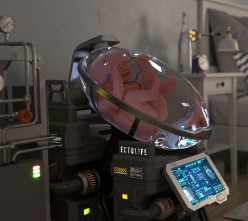
Ectolife artificial womb containing a plastic baby for demonstration purposes. Source: Parametric Architecture
Everyone is afraid to blame women. But a recent article in the New York Post about women in a bar complaining about not being approached by men produced a flood of comments from both men and women, along with horrifying anecdotes about the wreckage caused by the disastrous #MeToo movement, suggesting a widespread feeling of frustration.
"Decades of being accused of masculine toxicity, complaining about being flirted with, crying to HR every time a co-worker even looks in your direction. Yeah, consequences."
"If I were in a young man's shoes, it's simply too risky to both your life and career to take a chance that someone got offended and then ruins your life. Sorry ladies, but the false narrative about male masculinity has made the opposite sex very leery."
A related article pointed out something I hadn't considered: that freezing one's eggs and delaying childbirth until one's mid-forties is not as good a solution as women think. At that age, she will not only find it much harder to find a partner than at age twenty. If she's successful at her career she will also have even less time and energy to raise a child. She has a good chance of dying before the child reaches adulthood. And if her hormones aren't driving her to reproduce at age twenty, why would they start at menopause?
Social factors
Many people would prefer to make discussing the question taboo. The reason is simple: they can't think of a solution that wouldn't wreck their lifestyle, and that is unthinkable. And of course anyone mentioning the issue risks being accused of misogyny. But it is not just a women's issue. It is an issue of survival, and men are just as entitled to discuss it as women.
Clearly part of the reason is that women now have more control over whether to get pregnant. Since there are significant costs, increasingly they choose to avoid it altogether. Our view of sex is no longer tied to reproduction; sex has become a lifestyle issue, which is why we have gays, trans people, furries, and similar movements, which view sex in non-reproductive terms and are clamoring for acceptance.
Thanks to feminism, which portrayed the male-female relationship as a simplistic power dynamic, many women feel no shame in eliminating themselves from the gene pool entirely. To many women, becoming a ‘cat lady’ is not a disgrace, but something to be proud of. Some men have started to follow the same path, though they experience a significant loss of social status by doing so.
Dr Gilda Carle, author of a new book titled Real Men Don't Go Woke, says that when one woman on Instagram mentioned the high male suicide rate, another commented, “[Male suicide] rates [are] not high enough.” Almost 7,000 other women liked her comment. Carle concludes that misandry, not misogyny, is at work here; though its prevalence is sometimes denied, it is actually celebrated.
It's clear that lifestyle is tied up with the universal availability of contraception and women's rights. Giving birth and raising children is time-consuming and painful, perhaps worse than waking up at age 45 and realizing your life was spent chasing a career as bureaucrat with nothing to show for it but a cat and a fifty-cent printed certificate. Indeed, a large contingent of women believe that the male's wishes to the contrary are not important. So the two sexes avoid each other and the rate spirals downward.
Humans need to remember that nature is absolutely ruthless on this topic. If people stop reproducing the moment that sex is dissociated from reproduction, it introduces a strong selective pressure for people to be driven by the desire to reproduce instead of the desire for sexual gratification. If a society can't adapt to that new reality, many traits we depend on and currently enjoy, such as the approximate equality of IQ between the two sexes, will be rapidly eliminated by natural selection.
Biological factors and solutions
Many books have discussed possible causes. While some address the question honestly, they all propose simplistic solutions. A typical ‘solution’ is to give people more of what they say they want: free childcare, cheaper housing, free food, and so on. It has been shown repeatedly that this does not work. Likewise with the claim that ‘pollution’ is somehow affecting sperm viability. But there are many other possible causes and it's essential for science to rule them out.
One is behavior-modifying hormones. Perhaps because the topic seems frivolous, research on this topic has been amateurishly conceived and carelessly executed. Biologists are still stuck on androsta-4,16-dien-3-one (androstadienone, AND), research that has been described as “inconclusive” at best.[1] There's no doubt that pheromones exist, and they're enormously powerful. One could even speculate that the social isolation caused by cell phones is keeping males and females too far apart for pheromones to work. Yet discovering their chemical identity and how they work are a low priority from funding agencies.
Another possible factor is that humans are programmed to want to reproduce whenever their survival is threatened. This explains why Israel, whose survival has been threatened almost continuously since its founding, is almost alone among advanced nations in having a sustainable birth rate. Evidence suggests that we're genetically programmed to replace ourselves when our survival is in jeopardy, and to stop doing so when survival stress is low.
Proof that people in Western countries currently believe their survival is assured is the prevalence of boutique 'problems' that are mostly invented or exaggerated. There's a trend to blame some single factor, like ‘forever chemicals’, lack of religion, or ‘toxic masculinity’ rather than searching dispassionately for answers. That's because people refuse to consider any solution that would interfere with their lifestyle.
Are humans willing to become dependent on machines for reproduction?
It might sound heartless to say so, but the demographic crisis and the rise of the sexbots are two sides of the same phenomenon: if women can't or won't fulfill their biological role, we'll need a substitute. It's not a moral judgment; society would have no choice. Society is like a force of nature. Its only goal is survival.
Almost nobody wants a world where males are forced to mate with artificially intelligent female robots and women are replaced with artificial wombs, but that's where humans may be headed. It's a hard choice: the furor by conservatives over IVF is just one example of the resistance we would encounter.
It's not a new idea: The Twilight Zone had a story about children being raised by a robot nanny way back in 1962. Artificial womb technology has already left the laboratory, with start-up companies like Ectolife promising to provide a way for childless couples to produce kids.
Unless something dramatically changes, this will become routine. We'll be forced to choose between IVF and artificial wombs and eventual extinction. Maybe the dystopian nature of such a world will wake people up. Or maybe we just need to get used to the idea that using technology to interfere with biology, as we've been doing since the Pill was invented, is a one-way ratchet. It's one of those things, like getting pregnant, that you just can't do halfway.
As Yoda said, once down that path you start, forever will it dominate your destiny. . . if you have one.
[1] Gan J, Wu Y, Lei X, Han C. Is androstadienone a human male pheromone? More research is needed. Physiol Behav. 2025 Jan 1;288:114733. doi: 10.1016/j.physbeh.2024.114733. Epub 2024 Nov 5. PMID: 39510224. paywalled
jul 22 2025, 11:24 am. minor updates jul 23 2025. minor revision jul 27 2025