eading a science book takes you outside your ordinary problems and fills you
with the magnificence of the natural world. Since by 2027 there might
not be much of the natural world left, now is a good time to do it. It’s
been estimated that between 72 and 100 million books have ever been published.
How to choose?
eading a science book takes you outside your ordinary problems and fills you
with the magnificence of the natural world. Since by 2027 there might
not be much of the natural world left, now is a good time to do it. It’s
been estimated that between 72 and 100 million books have ever been published.
How to choose?
Don’t bother going to that book site whose name starts with a ‘g’. Most of the books there are just people stuff: humans making up lies about each other, killing each other, and so on. You can get that talking to your relatives and looking out the window.
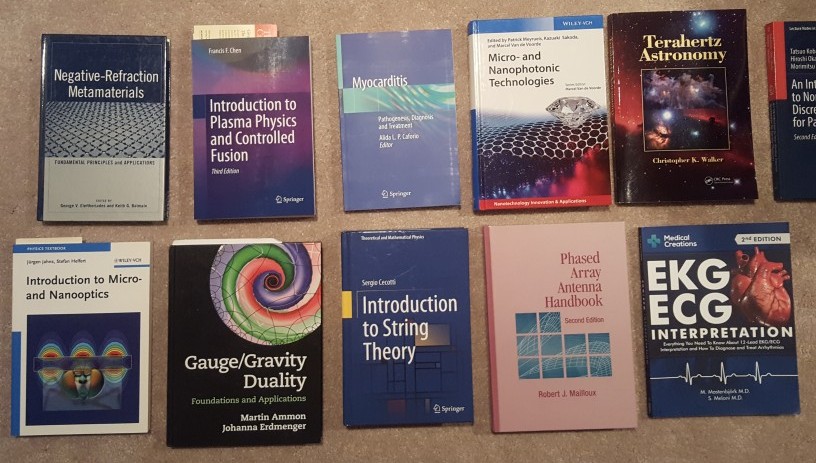
Recommended books, including some great ones that didn’t make the list
Another site recommends fluff books like Television: A Novel and So, I Met This Guy, which is billed as “confessions of a forty-something f**k up.” Translation: a male-bashing story for women who have screwed up their life.
No, there is only one source of actual knowledge left in this dark age, and that is science. Everything else is propaganda. So here are my recommendations. For some of them you might need a little background study. Others (okay, most of them) contain math. But if you want Truth about nature in this world, there are no alternatives.
You don’t have to read a scientific book from cover to cover. Most people read until they get confused or stuck, then search for answers online or in another book. For a beginner, this can be frustrating. But the goal isn’t to get to the end. The goal is to learn things. Unlike reading a novel, where you’re merely entertained for a few hours, reading a scientific book gives you the ability to read real scientific articles—the only kind of writing that is really about the search for truth about the natural world (though of course they don’t always find it and often make mistakes).
In practical terms, write down abbreviations and important points as you go, and avoid multi-author books.
1. Nonlinear wave and plasma structures in the auroral and subauroral geospace by Evgeny V. Mishin and Anatoly V. Streltsov.
Now that global warming has turned political, we have no way of knowing if the earth is getting warmer, colder, or staying the same. Even some scientific books are now biased. But there are still branches of science free of politics. Two of those are plasma physics and space weather.
With the possible exception of Francis F. Chen’s excellent Introduction to plasma physics and controlled fusion, 3rd edition, all the other books on plasma physics are pretty much the same. This one gives you a crash course in plasma physics, then turns to what we’re really interested in: auroras. It turns out that there are many more types than most people know about, like picket fence auroras, black auroras, and subauroral red arcs. This is the only book I know of that explains them, making it worth the slog.
2. Physics and Chemistry of the Upper Atmosphere by M. H. Rees.
You might also wish to read this one for background. Although it’s a little old, it’s a great way to understand why both the red and green in an aurora are caused by oxygen, while the blue is caused by nitrogen. It turns out that chemical reactions occur in the ionosphere, and they’re complicated, exotic, and interesting.
3. Physics of Nuclear Explosives by Dalton E. Girão Barroso.
Listen. If we’re going to get nuked by Putin or whoever replaces Xi by the end of the year, you need to know how those darn things work. You need to know as much as possible about the things that can kill you. There was a time you could read this stuff about criticality, hydrodynamic theory of detonations, and inertial confinement fusion online. Now it’s all being hushed up. Why? Read this book and you’ll be able to calculate the velocity of the compression wavefront before it hits you.
4. Myocarditis: Pathogenesis, Diagnosis, and Treatment by Alida L.P. Caforio, ed.
Everybody knows the Covid vax can cause myocarditis. If you’ve been vaxed, or if you got Covid, you might have a ticking time bomb in your body. But what exactly is myocarditis, what causes it, and how could being vaccinated damage your cardiovascular system? There’s lots of misinformation out there. This one isn’t about the vax, but it has twenty medical articles about how to diagnose myocarditis, how the immune system is involved, and how it causes arrhythmias. Ignore what I said about multi-author books. This is a good ’un.
Immune Cells, Inflammation, and Cardiovascular Diseases, edited by Shyam S Bansal, is a good alternative for readers more interested in the molecular immunology. Instead of H&E-stained sections, immunohistochemistry, and MRIs you get biochemical pathways, cytokines, and chemokines.
5. EKG ECG Interpretation: Everything you need to know about 12-lead EKG/ECG interpretation and how to diagnose and treat arrhythmias by M. Mastenbjörk MD and S. Meloni MD
Always, always, always know what disease you have, what the treatments are, what alternative explanations there may be for your symptoms, and the risks of the treatment before you let any doctor look at you. (Don’t tell the doctor your self-diagnosis, of course, but be prepared to provide information that might suggest some alternative diagnosis when the doctor guesses wrong.)
One way is to read this nontechnical book on electrocardiogram interpretation, intended for both medical practitioners and patients. You can follow along with the aid of inexpensive two-lead EKG machines like the little Emay portable ECG monitor and a tube of Spectra 360 electrode gel. The back cover says:
This book contains a massive list of all the diseases and clinical conditions related to EKG. Check out the table of contents!
For once, the back cover is correct. You can determine whether you have WPW syndrome or the nasty Torsades de Pointes, which scares the hell out of drug developers. It also has exercises to test your understanding. It doesn’t cover everything: vagus nerve stimulation and electrolyte imbalance aren’t given enough coverage. But if you’re going to visit a cardiologist, read this book before they start saying they want to operate. If you don’t, you’ll only have their word and you won’t be able to suggest an alternative.
6. An introduction to non-Abelian discrete symmetries for particle physics, second edition by Tatsuo Kobayashi, Hiroshi Ohki, Hiroshi Okada, Yusuke Shimizu, and Morimitsu Tanimoto
I admit this one is a bit technical: even Steven Weinberg left the difficult non-Abelian stuff for Volume 2 of his quantum field theory book. But it’s an important topic. These theories might be useful for calculating quark and lepton masses, mixing angles and charge-parity from discrete flavor symmetries. You might think quark masses were already known, but at the subatomic level distinguishing mass and energy is not trivial. Even more exciting is the application of string theory and compactification by orbifolding as geometrical symmetries. Mostly math. (Disclaimer: I haven’t finished this one yet.)
7. Optics experiments and demonstrations for student laboratories by Stephen G Lipson
Suppose you have three different pairs of glasses and three different prescriptions. One pair gets scratched up. How do you measure which prescription it was for? This book will tell you. It also tells you how to do holography with a digital camera, measure optical tunneling, measure refractive index of a gas, and study birefringent materials like calcite and polymethyl methacrylate (PMMA, a common plastic). Setting up an optics lab in your basement isn’t cheap, and this book is not for kids. If you’re not careful, you could get injured. But unlike in chemistry and particle physics, at least for optics you can get the materials.
8. Quantum measurement: theory and practice by Andrew N. Jordan and Irfan A. Siddiqi
Did you fall for the myth that the quantum world is non-deterministic? Did they tell you that collapsing a wavefunction is an instantaneous and irreversible transition from an indeterminate quantum state to a classical definite state? Boy, did you get suckered! This technical book by two experts in quantum optics tells you how a transmon qubit works and along the way explains why all the mysticism about quantum mechanics was caused by physicists who forgot to include the measurement apparatus in their theories about quantum measurement.
9. Dark Matter: Evidence, Theory, and Constraints by David J.E. Marsh, David Ellis, and Viraf M. Mehta
Everyone talks about dark matter as if they’re sure it’s real. These authors say their models of the cosmic microwave background (CMB) power spectrum are strong evidence for dark matter. But nobody knows what it might be. One candidate is primordial black holes. The authors favor sterile neutrinos, which a recent paper argues might not exist. Another candidate is axions, which have never been detected. Even worse, no one has a clue what axion mass might be. An exciting new experiment planning to measure ‘high-energy’ axions is in the news, but from the description it looks guaranteed to fail. The science is well described in this book, so you’ll understand why.
10. Black Hole Physics: From Collapse to Evaporation by Daniel Grumiller and Mohammad Mehdi Sheikh-Jabbari
Despite that famous radioastronomy picture purporting to show the accretion disk of a black hole, no one has ever really seen one. All we have are mathematical theories, like the ones in this book. Physicists find black holes interesting because they test the limits of their theories about spacetime. This book assumes familiarity with general relativity and basic quantum field theory. It’s not an easy read but if you want to know what people are really thinking about black holes, you need this book. There’s no index, so you have to take a lot of notes.
jan 01 2026, 7:33 am. updated jan 05 2026