erotoxic syndrome is a neurological disorder caused by toxic chemicals
such as tricresyl phosphate and carbon monoxide entering the cabin of an
airplane during flight.[1]
erotoxic syndrome is a neurological disorder caused by toxic chemicals
such as tricresyl phosphate and carbon monoxide entering the cabin of an
airplane during flight.[1]
Tricresyl phosphate (TCP) is an organophosphate used as a metal passivating antiwear additive and flame retardant in jet engine hydraulic fluids and lubricating oil. It is a colorless, odorless, viscous liquid with a high boiling point (410°C), so it would be present as an aerosol, which is to say a cloud of ‘smoke’ or ultrafine particles that will gradually precipitate onto surfaces. TCP, when found, may be present at anywhere from 0.05–0.1 microgram/cubic meter [2] or 0.22 microgram/cubic meter.[3] Levels of TCP as high as 1500 have been measured when a ‘fume event’ occurs.[4] The MSDS says the NIOSH and OSHA limits for TCP are 0.1 milligram per cubic meter, that mouth-to-mouth resuscitation should not be done, and that paralysis in humans can occur at 10–30 mg/kg body weight.
Carbon monoxide (CO) is a colorless, odorless gas produced by incomplete combustion. The FAA limits carbon monoxide, or CO, to 50 parts per million in Section 25.831(b). CO has been found in normal airplanes at levels of 1150 µg/cubic meter, which equates to 1.006 ppm.
These compounds can enter the cabin and flight deck from air taken in or ‘bled’ from the main engines. Both of them are potentially dangerous. So aerotoxic syndrome is not just another scare story invented by news media to distract us from important things. But what do these molecules do? Can just flying on a plane expose you to enough of them to cause permanent harm?
The WSJ recently claimed in a paywalled article that incidents of fume events are increasing. This is useful information, as many people have never heard of aerotoxic syndrome. The fact that the media have a history of inventing baseless scare stories about chemicals means we must be skeptical, and so far most of what we have are anecdotes and soft numbers. We need hard numbers, but the abundance of cases suggests that it's not another media panic about tiny amounts of chemicals, but something real.
What do these toxins do?
Toxins on a plane
TCP and CO are both said to be demyelinating agents,[5] which means they damage the white matter connections between neurons in the brain in much the same way as multiple sclerosis. This is called Grinker's myelinopathy.
A related molecule called tributyl phosphate, the principal component in hydraulic fluid, is not thought to be neurotoxic. It is also unlikely to get into the cabin. However, there's a lot more of it than TCP,[6] so it still could be a hazard if there were a hydraulic leak. Many other compounds are produced from TCP by pyrolysis at high temperatures. Their toxicity and even their chemical identities are mostly unknown, so they might account for some of TCP's toxicity.
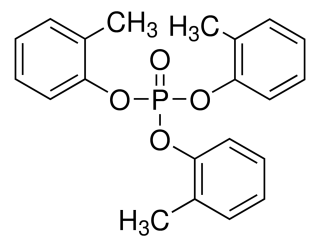
Tri-ortho-cresyl phosphate (ToCP) ‘Ortho’ means the two groups on the aromatic rings are adjacent to each other. Tricresyl phosphate (TCP) is a mixture of the ten possible ways the three CH3 groups can be attached. At high temperatures, they can be interconverted, which means that it would be hard to completely eliminate ToCP from TCP
Neuropathology of TCP
TCP (tricresyl phosphate) is known mainly from an incident in the 1920s when it was found as an adulterant in Jamaican ginger and produced thousands of cases of limb paralysis. Ginger is mostly harmless, but short term exposure to TCP causes chest pain, eye irritation, and headache. Long-term exposure causes memory loss, numbness, loss of coordination, sleep disorders, headaches, immunosuppression, muscle pain, cognitive dysfunction, and fatigue.[19] Effects may be delayed and can be cumulative. Airplane pilots have reported headaches, dizziness, tunnel vision, and memory loss.[2] One study found that 40% of frequent flyers reported ‘malaise’ following a jetliner flight.[7] Early symptoms can be hard to distinguish from the effects of mild hypoxia and dehydration from the thin dry air in the plane. The difference is that neurotoxic effects, if they occur, could cause long-lasting disability or even be fatal.
Pilots are reluctant to report any symptoms at all, as any evidence of sickness could cost them their pilot's license on medical grounds. One pilot on record was forced to abandon his career due to symptoms of aerotoxic syndrome and died a year later. An autopsy revealed extensive neurological damage.[8] However, it was impossible to prove that his death was caused by TCP.
The term ‘organophosphates’ suggests pesticides and nerve gases, which cause ‘cholinergic crisis’ with symptoms of mental agitation, headaches, nightmares, and pupillary constriction caused by inhibition of acetylcholinesterase, the enzyme that breaks down the neurotransmitter acetylcholine. The classic antidote is atropine, an alkaloid that blocks muscarinic cholinergic receptors. For exposures to nerve agents, more powerful drugs, not available to the public, can be used.
Cholinergic symptoms are not found after TCP and ToCP poisoning, so it's believed that some other esterases, such as neuropathy target esterase (NTE) and butyrylcholinesterase (BChE), may be involved. The insidious nature of TCP toxicity is that it can be delayed by days or weeks, after which sensory and motor neurons degenerate. This is called organophosphate-induced delayed polyneuropathy or OPIDPN or OPIDN. The peripheral neuropathy gradually resolves and is followed by a CNS deficit.[9]
TCP is a mixture of isomers, and the tri-ortho-cresyl-phosphate isomer ToCP is said by some (but not all) researchers to be more neurotoxic than other isomers. TCP is metabolized in the liver to 2-(o-cresyl)-4H-1,3,2-benzodioxaphosphoran-2-one (CBDP), aka cresyl saligenin phosphate.[1] This molecule is a highly toxic organophosphorus compound that requires special handling in the lab. This toxic metabolite reacts with histidine groups on proteins.
Some researchers believe that CBDP is primarily responsible for the OPIDN induced by high doses of ToCP.[19] If so, then there might be a threshold below which little or no toxicity would occur until BChE binding in the blood plasma was saturated. However, there are other biochemical ways that ToCP could cause nerve damage.

Carbon monoxide isn't rare. It's the second most abundant molecule in the universe after hydrogen (H2). It has a triple bond between a carbon and oxygen atom. It's by far the most structurally boring carbon-containing molecule. It's so boring we have to draw the four unpaired electrons to make it interesting
Which airplanes are safest
The Boeing 787 is currently the safest jet airplane because it uses a different design. In a 787, compressed air is taken from outside instead of engine bleed. This is a technological change in modern engines that have an increased bypass ratio, which makes it less economical to bleed air from the engine.
Even though the 787 will someday make aerotoxic syndrome a moot point, passengers and crew in older planes would be at potential risk for decades to come.
Carbon monoxide detectors
The only way to know whether that risk is real would be to measure them continuously in flight. This is something the airlines must do. Most passengers aren't qualified to decide chemical risks on their own. Passengers are also not permitted to bring carbon monoxide detectors into the cabin for three reasons.
They contain lithium ion batteries, which are regarded as a fire hazard.
Most household detectors don't display the amount of CO or whether it exceeds the 50 ppm limit allowed by the FAA. There may also be doubt as to whether the detector is picking up CO or something else, or maybe even malfunctioning.
They will emit a loud screeching noise that will create alarm among the passengers. The flight attendant will just tell you to remove the battery. If you don't, or if the pilot is told that CO is present in the cabin, the pilot will likely land the plane and have you arrested for disrupting a flight unless you can prove CO poisoning (e.g., by being dead).
ToCP detectors
TCP and ToCP can be detected by specialized electrochemical detectors or by gas chromatography / mass spectrometry (GCMS). Usually a sampling tube is used rather than measuring in flight. Airlines would probably recommend that you do not bring your GCMS in your carry-on baggage.
The disadvantage of sampling tubes is that they provide only a single data point averaged over the entire flight. The results are available only later, when it's too late for the crew to mitigate any exposure.
Another possible way of measuring exposure is biomarkers, which would mean that passengers would be invited to provide blood samples after a flight if they feared TCP exposure. One possible biomarker is phosphorylated BChE, which was first detected in 6 out of 12 asymptomatic airline passengers in 2011.[20] This is evidence that passengers are indeed being exposed to small amounts of TCP, but the biomarker has not yet been validated or officially approved.
Neuropathology of Carbon Monoxide (CO)
Carbon monoxide binds hemoglobin, preventing oxygen from reaching the tissues. Short-term symptoms are identical to anemic hypoxia: headache, nausea, shortness of breath, followed by dizziness, exhaustion, confusion, angina, and death. The effectiveness of treatment with hyperbaric oxygen is controversial.[10] Pathologists recognize acute CO poisoning instantly, as the brain remains bright red long after death.
About 12–13% of CO-poisoned patients who survive appear to recover, but suffer two weeks later from delayed encephalopathy after carbon monoxide poisoning (DEACMP).[11] It has a poor prognosis. It is caused by cell loss in the globus pallidus (a part of the basal ganglia) and nearby brain regions.[12] Doses of CO that aren't high enough to cause rigidity and coma can cause psychic akinesia, where the patient becomes inactive and lethargic and falls into an amotivational state with insomnia, gait disturbance, bradykinesia (slow movement), and tremor resembling Parkinson's disease.[13] However, it is not real Parkinson's and does not respond to L-DOPA.
CO is also a signaling molecule found normally in the body. It is a potent anti-inflammatory agent and low doses might counteract sepsis and apoptosis, aka programmed cell death.[16] Since administering CO as a gas is too hazardous, researchers invented carbon monoxide releasing molecules or CORMs, small molecules with CO complexed to a metal ion such as ruthenium or manganese that release precise amounts of carbon monoxide.[14] There are still some doubts about whether they all actually work as advertised. For example, CORM-2, releases carbon dioxide instead of CO, while the benefits of CORM-3 were found to be due to the ruthenium.[15]
One report suggests that cigarette smoking, which is known to reduce the risk of Parkinson's, acts by elevating CO levels in Parkinson's disease patients.[17][18] If true, it may give us clue about the cause of Parkinson's disease.
As with all toxins, concentration and time make the difference between mere annoyance and risk. In real-world exposure, it's hard to know if you've received enough toxin to cause injury. It's easy enough to keep a CO monitor in your car. Considering the risk of a pilot becoming even mildly impaired, continuous monitoring these neurotoxins in planes is a no-brainer.
Update, sep 28 2025
On discussion boards for professional pilots, pilots report “losing their medical” due to neurological symptoms, which means loss of their flying certificate and grounding, which ruins their career. Others report flight crews becoming incapacitated when the PACK (pressure and air conditioning kit) is turned on. The belief is that ToCP is associated with an unpleasant “old sweaty sock” odor, that rapid APU (auxiliary power unit) shutdown is often at fault, at least in Airbus planes, and that charcoal filters should be added to the airstream. A major concern is about acute and chronic effects and fumes being dismissed as de-icer or particulates.
People in the fuel industry point out that the sweaty sock odor is not from TCP itself, but from breakdown of synthetic esters of neopentyl polyols, which comprise 94–95% of the jet oils. Thermal breakdown of these esters releases C5 fatty acids, which produce the sock odor. This means that TCP poisoning can occur without the sweaty sock odor. C5 fatty acids (such as valeric acid) merely smell bad and are harmless, but their presence could be a clue that toxins are present. The smell of sweaty feet also occurs in a genetic disorder called isovaleric acidemia due to isovaleric acid.
The reports of one person being incapacitated while the person sitting next to them is unaffected are consistent with a threshold effect mentioned above. This could be explained, for instance, if a person is exposed to two fume events in a short period.
Correction This page has been corrected to show that the BP of TCP is 410C.
[1] Ramsden JJ. Aerotoxic Syndrome-Susceptibility and Recovery. Toxics. 2025 May 22;13(6):420. doi: 10.3390/toxics13060420. PMID: 40559894; PMCID: PMC12196834. https://pubmed.ncbi.nlm.nih.gov/40559894/
[2] de Boer J, Antelo A, van der Veen I, Brandsma S, Lammertse N. Tricresyl phosphate and the aerotoxic syndrome of flight crew members--current gaps in knowledge. Chemosphere. 2015 Jan;119 Suppl:S58–61. doi: 10.1016/j.chemosphere.2014.05.015. PMID: 24925093. Paywalled.
[3] Crump, D.; Harrison, P.; Walton, C. Aircraft Cabin Air Sampling Study; Cranfield University: Cranfield, Bedfordshire, UK, 2011. Cited in [1]
[4] Ramsden, J.J. Jet engine oil consumption as a surrogate for measuring chemical contamination in aircraft cabin air. J. Biol. Phys. Chem. 2013, 13, 114–118
[5] Aldridge, W.N. Tricresyl phosphates and cholinesterase. Biochem. J. 1954, 56, 185–189.
[6] He RW, Houtzager MMG, Jongeneel WP, Westerink RHS, Cassee FR. In vitro hazard characterization of simulated aircraft cabin bleed-air contamination in lung models using an air-liquid interface (ALI) exposure system. Environ Int. 2021 Nov;156:106718. doi: 10.1016/j.envint.2021.106718. Erratum in: Environ Int. 2022 Aug;166:107365. doi: 10.1016/j.envint.2022.107365. PMID: 34166876. https://pubmed.ncbi.nlm.nih.gov/34166876/
[7] Mulder, M.F.A. Health complaints among frequent flyers. J. Biol. Phys. Chem. 2024, 24, 9–16.
[8] Abou-Donia, M.B.; van de Goot, F.R.W.; Mulder, M.F.A. Autoantibody markers of neural degeneration are associated with post-mortem histopathological alterations of a neurologically injured pilot. J. Biol. Phys. Chem. 2014, 14, 34–53
[9] Greenfield's Neuropathology, Love, Louis, Ellison eds, 8th ed, p 1695.
[10] Ning K, Zhou YY, Zhang N, Sun XJ, Liu WW, Han CH. Neurocognitive sequelae after carbon monoxide poisoning and hyperbaric oxygen therapy. Med Gas Res. 2020 Jan–Mar;10(1):30–36. doi: 10.4103/2045-9912.279981. PMID: 32189667; PMCID: PMC7871936.
[11] Liu J, Si Z, Liu J, Lin Y, Yuan J, Xu S, He Y, Zhang T, Wang A. Clinical and Imaging Prognosis in Patients with Delayed Encephalopathy after Acute Carbon Monoxide Poisoning. Behav Neurol. 2020 Dec 7;2020:1719360. doi: 10.1155/2020/1719360. PMID: 33376556; PMCID: PMC7744233.
[12] Chang CC, Chang WN, Lui CC, Huang SH, Lee CC, Chen C, Wang JJ. Clinical significance of the pallidoreticular pathway in patients with carbon monoxide intoxication. Brain. 2011 Dec;134(Pt 12):3632–3646. doi: 10.1093/brain/awr287. PMID: 22094539.
[13] Mano T, Yamanaka A, Akagi Y, Sugie K. Bilateral Striatal Hemorrhaging after Acute Carbon Monoxide Intoxication. Intern Med. 2023 Oct 15;62(20):3095–3096. doi: 10.2169/internalmedicine.1063–1122. PMID: 36889714; PMCID: PMC10641183.
[14] Choi HI, Zeb A, Kim MS, Rana I, Khan N, Qureshi OS, Lim CW, Park JS, Gao Z, Maeng HJ, Kim JK. Controlled therapeutic delivery of CO from carbon monoxide-releasing molecules (CORMs). J Control Release. 2022 Oct;350:652–667. doi: 10.1016/j.jconrel.2022.08.055. PMID: 36063960. Paywalled.
[15] Bauer N, Yuan Z, Yang X, Wang B. Plight of CORMs: The unreliability of four commercially available CO-releasing molecules, CORM-2, CORM-3, CORM-A1, and CORM-401, in studying CO biology. Biochem Pharmacol. 2023 Aug;214:115642. doi: 10.1016/j.bcp.2023.115642. PMID: 37321416; PMCID: PMC10529722.
[16] Kwong AM, Luke PPW, Bhattacharjee RN. Carbon monoxide mechanism of protection against renal ischemia and reperfusion injury. Biochem Pharmacol. 2022 Aug;202:115156. doi: 10.1016/j.bcp.2022.115156. PMID: 35777450.
[17] Rose KN, Zorlu M, Xue X, Fassini A, Cai W, Lin S, Webb P, Schwarzschild MA, Chen X, Gomperts SN. Neuroprotection of low dose carbon monoxide in Parkinson's disease models commensurate with the reduced risk of Parkinson's among smokers. bioRxiv [Preprint]. 2024 Feb 11:2023.05.27.542565. doi: 10.1101/2023.05.27.542565. PMID: 37398030; PMCID: PMC10312428.
[18] Wu YH, Hsieh HL. Roles of Heme Oxygenase-1 in Neuroinflammation and Brain Disorders. Antioxidants (Basel). 2022 May 8;11(5):923. doi: 10.3390/antiox11050923. PMID: 35624787; PMCID: PMC9137505. https://pubmed.ncbi.nlm.nih.gov/35624787/
[19] Carletti E, Schopfer LM, Colletier JP, Froment MT, Nachon F, Weik M, Lockridge O, Masson P. Reaction of cresyl saligenin phosphate, the organophosphorus agent implicated in aerotoxic syndrome, with human cholinesterases: mechanistic studies employing kinetics, mass spectrometry, and X-ray structure analysis. Chem Res Toxicol. 2011 Jun 20;24(6):797–808. doi: 10.1021/tx100447k. PMID: 21438623; PMCID: PMC3118852. https://pubmed.ncbi.nlm.nih.gov/21438623/
[20] Liyasova M, Li B, Schopfer LM, Nachon F, Masson P, Furlong CE, Lockridge O. Exposure to tri-o-cresyl phosphate detected in jet airplane passengers. Toxicol Appl Pharmacol. 2011 Nov 1;256(3):337–347. doi: 10.1016/j.taap.2011.06.016. PMID: 21723309; PMCID: PMC3205265. https://pubmed.ncbi.nlm.nih.gov/21723309/
sep 16 2025, 5:40 am