Alien
|
 cid
for blood - could be a silicon-based life form. Boron and phosphorus
also form polymers with oxygen. Strong acid might very well be advantageous
to such a creature. But why would a silicon-based life form want to incubate
inside a carbon-based creature? First of all, the creature's blood, and any
other secretions, would dissolve the host. Carbon-based life contains little
silicon, and would have little or no nutrient value. And there are
constant risks from crazy carbon-based ladies with flame throwers. cid
for blood - could be a silicon-based life form. Boron and phosphorus
also form polymers with oxygen. Strong acid might very well be advantageous
to such a creature. But why would a silicon-based life form want to incubate
inside a carbon-based creature? First of all, the creature's blood, and any
other secretions, would dissolve the host. Carbon-based life contains little
silicon, and would have little or no nutrient value. And there are
constant risks from crazy carbon-based ladies with flame throwers.
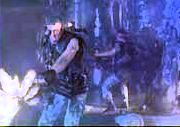
According to the first Alien movie, the creature has an outer layer
of protein polysaccharides with a coating of crystalline silicon. If so, it
would probably have a coating of silicon on the inside as well, to prevent
its acidic blood from dissolving the protein.
Even in humans, there are some types of protein that cannot be
dissolved by acid. A perfect example is the protein in the plaques
found in the brains of people with a certain neurodegenerative disease.
These proteins cannot even be dissolved by trifluoroacetic acid, a
powerful acid commonly used to dissolve protein for experimentation.
Moreover, some carbon-based animals, like ants, produce and secrete
strong acid. Many species of ants spray their victims with formic acid,
as a sort of preliminary meat tenderizing step. The bombardier beetle
squirts a boiling hot mixture of hydrogen peroxide and hydroquinone.
Although these aren't acids, they have a similar effect on their victims.
But even if the creature in Alien were based on carbon, the
chances of it being able to digest human protein are minimal.
For one thing, the amino acids would likely all be different. For animals,
even a change of an amino acid into its mirror image (e.g. from L-alanine to
D-alanine) completely changes its biological function, often changing it
from a nutrient into a deadly poison. Alien creatures, who evolved in a
biosphere with a different complement of amino acids, would get sick and
die if they ate us. And it would serve them right. Come to think of it,
maybe that's why the creature in Alien acts so unfriendly.
The same thing with viruses from outer space. Viruses on Earth evolved
alongside their hosts, becoming more effective over time by gradually
mutating using the process of evolution. A virus in space, even if its DNA
structure were somehow compatible with ours, would have a zero chance of
infecting a human because it never had the opportunity to coexist with one.
|


 loning involves inserting bits of DNA into specific sites, known as
restriction sites. The title "GATTACA" itself, although obviously selected
to suggest a prison society, is supposed to be a restriction enzyme site.
Needless to say, GATTACA could never be a real restriction site.
Restriction sites are all palindromic with their complementary sequences,
which means they read the same backwards as forwards.
The complementary sequence is made by matching G with C and A with T.
For example, look at the Eco RI site (GAATTC), on the left, compared with GATTACA:
loning involves inserting bits of DNA into specific sites, known as
restriction sites. The title "GATTACA" itself, although obviously selected
to suggest a prison society, is supposed to be a restriction enzyme site.
Needless to say, GATTACA could never be a real restriction site.
Restriction sites are all palindromic with their complementary sequences,
which means they read the same backwards as forwards.
The complementary sequence is made by matching G with C and A with T.
For example, look at the Eco RI site (GAATTC), on the left, compared with GATTACA:
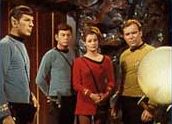
 any
movies and TV shows, including Buffy the Vampire Slayer and
Star Trek, depict a process in which the minds of two people are
switched into each other's bodies. Sometimes, the mind is just removed and
stored in a globe or a computer and then (usually) returned to its original
owner later in the movie.
any
movies and TV shows, including Buffy the Vampire Slayer and
Star Trek, depict a process in which the minds of two people are
switched into each other's bodies. Sometimes, the mind is just removed and
stored in a globe or a computer and then (usually) returned to its original
owner later in the movie.
 he fly illustrates the hazards of
eating too much sugar. (Not
finished.) Help me
he fly illustrates the hazards of
eating too much sugar. (Not
finished.) Help me
 on't
get me started. Super-intelligent talking viruses. Creating vaccines
in five minutes. Sheesh. The only parts of this show that were realistic
were the scenes where the two scientists bitch at each other and accuse
each other of stealing their work.
on't
get me started. Super-intelligent talking viruses. Creating vaccines
in five minutes. Sheesh. The only parts of this show that were realistic
were the scenes where the two scientists bitch at each other and accuse
each other of stealing their work.
 ot
finished.
ot
finished.

 ou
don't have to be a biochemist to know that changing a person into a
different species is impossible no matter how advanced your technology.
In one episode of Star Trek Voyager, Captain Janeway and Tom Paris both
change into Gila monsters and then go off to some distant planet to mate.
Luckily, the ship's doctor is able to easily reverse the changes. This
story was so bad that I'm sure even the screenwriters were embarrassed
by it.
ou
don't have to be a biochemist to know that changing a person into a
different species is impossible no matter how advanced your technology.
In one episode of Star Trek Voyager, Captain Janeway and Tom Paris both
change into Gila monsters and then go off to some distant planet to mate.
Luckily, the ship's doctor is able to easily reverse the changes. This
story was so bad that I'm sure even the screenwriters were embarrassed
by it.